Japan Train Etiquette: The Unwritten Rules Locals Follow
Japan train etiquette from the railways' own notices. Where to queue, which side of the escalator to stand on, priority seats, women-only cars, backpacks and rush hour.
On this page
- 🚉 How do you queue for a train in Japan?
- 🛗 Which side of the escalator do you stand on, Tokyo or Osaka?
- 💺 What are priority seats, and can you sit in them?
- 🚺 What are women-only cars, and when do they run?
- 🎒 Should you wear your backpack on the front?
- ⏰ When is rush hour in Tokyo and Osaka?
- 🎫 How do you pay for trains without slowing everyone down?
- ❓ FAQ
- 🧳 Quick recap
- Sources
Disclosure Some links on this page are affiliate links. If you buy through them we may earn a small commission at no extra cost to you. It never changes what we recommend.
This article contains affiliate links. We may earn a commission at no extra cost to you.
It's 8:15 on your first morning in Tokyo. The platform is packed, but nobody is pushing. People stand in neat lines at marks painted on the floor. Most of what you need to know is in that one picture: line up at the marks, let people off first, keep quiet, and keep your bag out of other people's way.
Very little of this is law. It's habit, and Japanese railways print it in their manners notices. Here's what those notices actually ask for, and how to blend in from day one.
The short version:
- Queue at the platform marks, and step aside so people can get off first.
- On escalators, the railways now ask everyone to stand still on both sides.
- Leave the morning rush (about 7:30–9:30 in Tokyo) to commuters, and the trip gets much easier.
🚉 How do you queue for a train in Japan?
This is the one rule every railway agrees on. Look down before the train arrives.
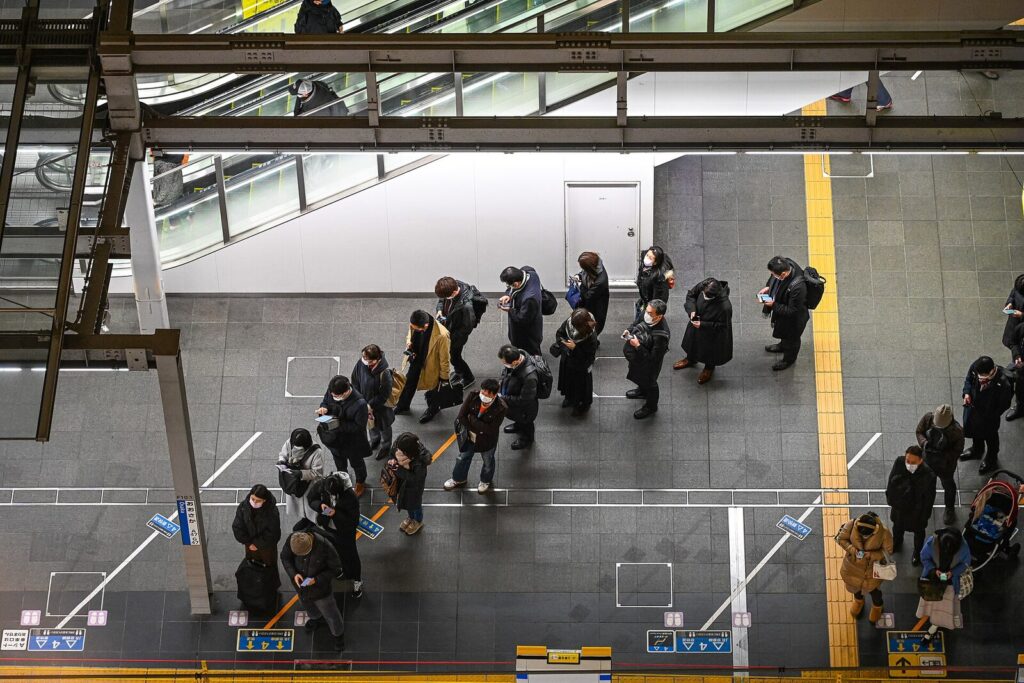
Osaka Metro's English manners page says it plainly: "Lining up to board is a basic rule for taking trains in Japan." Find the boarding marks painted on the platform and form two or three lines there. The same page says cutting in and saving places in the line are strictly prohibited.
When the doors open, the lines split to the sides of the doors. People get off first, then the lines get on. JR Hokkaido's manners guide asks for the same thing, and adds one more step: once you're on, move inside instead of stopping by the door.
That last part is the one visitors miss. Standing right inside the door with a suitcase feels polite. It actually blocks everyone behind you.
🛗 Which side of the escalator do you stand on, Tokyo or Osaka?
Here's the local habit. In Tokyo you'll see people stand on the left and leave the right side for walkers. In Osaka it's the other way round: stand on the right, walk on the left.
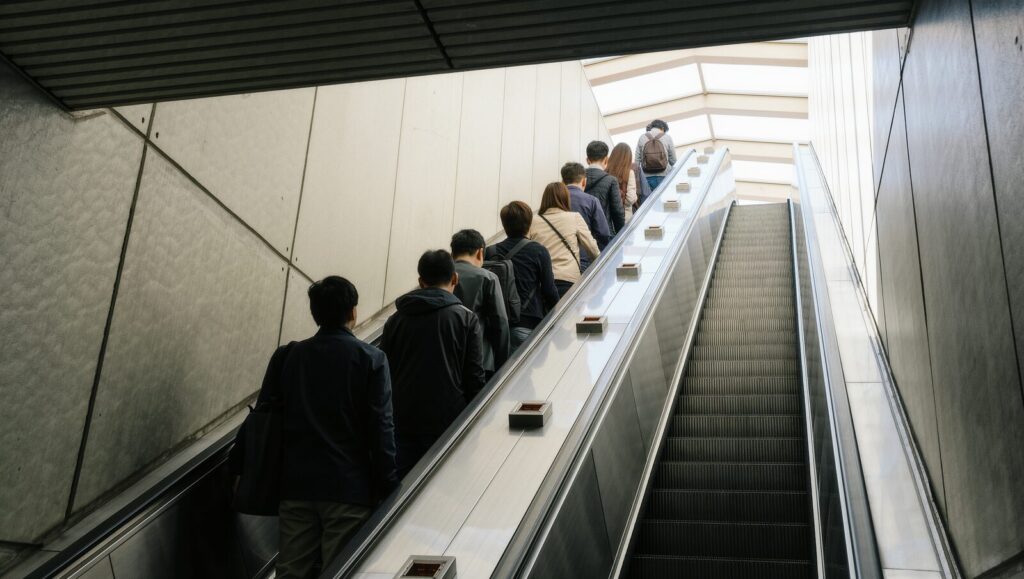
Nobody knows for sure where Osaka's habit came from. A Mynavi News report collected memories of announcements at Hankyu's Umeda Station around 1967 that asked riders to leave the left side open for people in a hurry. Others link it to Expo '70. One Osaka woman in her 40s told the reporter that standing on the right is the world standard anyway. The report's conclusion was that standing right is mainly an Osaka thing. Kyoto residents it spoke to mostly stood on the left, Tokyo style.
Now the part most English guides leave out. The railways themselves are asking everyone to stop walking on escalators completely. In July 2026, Tokyo Metro announced that the yearly campaign was starting again, backed by 58 railway operators. The slogans are arukazu ni tachidomarō (歩かずに立ち止まろう, "don't walk, stand still") and tesuri ni tsukamarō (手すりにつかまろう, "hold the handrail"). The reasons given: people fall, walkers bump into others, and some people can only hold one particular handrail.
Honestly, the simplest plan is this. Stand still and hold the rail. If everyone around you is lined up on one side, join that side, and you'll fit in anywhere in Japan.
💺 What are priority seats, and can you sit in them?
Yūsenseki (優先席, priority seats) are near the ends of each car, marked by a different seat colour or signs. Osaka Metro says they are for older people, people with disabilities, pregnant women and parents with small children, and asks riders to keep them free for those who need them.
Many locals will sit there when the car is empty and stand up the moment someone needs the seat. JR Hokkaido's guide adds a kind reminder: not every need is visible.
Phones follow a rule of their own. Since October 2015, railways in eastern Japan, including Tokyo Metro, have asked passengers to switch their phones off near priority seats when the train is crowded. And on any train, Japanese railways ask you not to make phone calls at all. Messaging is fine. Talking out loud is the thing people notice.
🚺 What are women-only cars, and when do they run?
Josei senyō sharyō (女性専用車両, women-only cars) are marked with pink stickers on the platform and on the car windows. They exist to give women a safer ride in crowded trains. Tokyo and Osaka run them very differently:
| Where | When it runs | Who can ride |
|---|---|---|
| Tokyo Metro (Hibiya, Tozai, Chiyoda, Yurakucho, Hanzomon, Fukutoshin lines) | Weekday mornings, ending at 9:00 or 9:30 depending on the line | Women, children up to primary school age, passengers with disabilities and their carers |
| Osaka Metro Midosuji Line | All day on weekdays | Same groups |
| Osaka Metro Tanimachi Line | Weekdays, first train until 9:00 | Same groups |
| JR West (Osaka Loop Line, JR Kyoto, Kobe lines and more) | Every day, first train to last | Women, boys in year 6 of primary school or younger, passengers with disabilities and their helpers |
The surprise is in Kansai. On JR West, the women-only car runs all day, every day, weekends included. So if you're a man travelling with a suitcase on the Osaka Loop Line at 3pm, check the floor marks before you get on. If you do step in by mistake, just move to the next car at the next stop. Nobody expects more than that.
🎒 Should you wear your backpack on the front?
Take it off your back. Exactly where it goes next depends on the railway.
Osaka Metro asks you to wear it on your front or put it on the rack above the seats. JR Hokkaido asks you to hold it in your hand or use the rack. Both mention the overhead rack, so that's the choice that works everywhere. On a crowded train, a backpack on your back hits the person behind you every time the train sways.
Big suitcases follow the same idea. JR Hokkaido asks you to keep aisles and doorways clear and use the luggage spaces.
⏰ When is rush hour in Tokyo and Osaka?
Look at the women-only car hours above. They end at 9:00 or 9:30 because that's when the morning crush starts to ease.
The numbers explain why it's worth working around. Japan's transport ministry (MLIT) measures how full trains get in the busiest hour of the morning. In its July 2026 release for the 2025 business year, the Tokyo area averaged 143% and the Osaka area 117%. In everyday terms, Tokyo morning trains run well past "every seat taken and every strap held".
My honest take: plan your first train of the day for after 9:30 on weekdays. You lose nothing, because most temples, museums and shops don't open until around then. You also get a seat, room for your bag, and a much calmer start. Fridays from early evening get busy again, so that's a good time to be at dinner instead of on a platform.
🎫 How do you pay for trains without slowing everyone down?
The quickest way through the gates is an IC card. That's a rechargeable travel card you tap on the reader, so one card covers every ride instead of a new ticket each time.
PASMO's visitor page says PASMO is one of 10 IC cards that work together, along with Suica and ICOCA. Wherever you see the logo, you can use any of them on trains, buses and in shops across Japan. You can also keep one on your iPhone: PASMO, Suica and ICOCA all work in Apple Pay. One thing to check if you use Android: PASMO says Android phones bought outside Japan can't use Mobile PASMO.
Landing in Kansai? JR West sells a visitor ICOCA at the JR ticket office at Kansai Airport Station for ¥2,000 as of 2026-10. That includes a ¥500 deposit, and it's one card per person.
If you're crossing the country by Shinkansen, compare a rail pass with single tickets for your actual route before you go. For city trains, the IC card does the job.
❓ FAQ
Is it rude to talk on the train in Japan?
Quiet conversation is fine. Phone calls are the thing to skip. Railways ask you not to make calls on board.
Can I eat on trains in Japan?
On long-distance trains like the Shinkansen, yes. Bento on board is part of the fun. On packed city trains, most locals wait.
Can men ride women-only cars outside the set hours?
Yes. Outside the hours shown on the platform signs, they're ordinary cars. On JR West lines in Kansai, the women-only car runs all day, so check the floor marks there.
Should I stand left or right on escalators in Kyoto?
Mynavi News found Kyoto residents mostly stood on the left, like Tokyo. The easiest rule is still to copy the person in front of you and hold the handrail.
Do I need cash for trains?
Not if you have an IC card in your phone or wallet. Ticket machines take cash if you need to top up a physical card.
🧳 Quick recap
- Line up at the painted marks, let people off first, then move inside the car.
- Stand still on escalators and hold the rail. Tokyo leans left and Osaka leans right, but standing still works everywhere.
- Take your backpack off and use the overhead rack when the train is busy.
- Start your weekday sightseeing after 9:30, after the commuter rush.
- Before you fly, set up an IC card on your phone or plan where to pick one up, and check whether a rail pass fits your long-distance route.
Book it before you fly

Klook — tickets, tours and rail
- Good forTheme parks, day trips, rail passes
- BookingInstant e-tickets to your phone
- LanguagesEnglish and more

KKday — tickets and experiences
- Good forExperiences, transfers, day tours
- BookingE-tickets and vouchers
- LanguagesEnglish and more
Show sources
- Osaka Metro Manners — Osaka Metro Co., Ltd. (accessed 2026-10-16)
- 女性専用車 — Tokyo Metro Co., Ltd. (accessed 2026-10-16)
- エスカレーター「歩かず立ち止まろう」キャンペーンの実施について — Tokyo Metro Co., Ltd. (accessed 2026-10-16)
- 優先席付近における携帯電話使用マナーを「混雑時には電源をお切りください」に変更します — Tokyo Metro Co., Ltd. (accessed 2026-10-16)
- JR北海道マナーガイド — Hokkaido Railway Company (accessed 2026-10-16)
- 女性専用車両・女性専用席 | JRおでかけネット — West Japan Railway Company (accessed 2026-10-16)
- エスカレーターの追い越し、大阪ではなぜ左側? — Mynavi News (accessed 2026-10-16)
- 平均混雑率が東京圏・大阪圏で増加、名古屋圏は横ばい — Ministry of Land, Infrastructure, Transport and Tourism (MLIT) (accessed 2026-10-16)
- ICOCA – How to use JR-West — West Japan Railway Company (accessed 2026-10-16)
- PASMO for visitors — PASMO Co., Ltd. (accessed 2026-10-16)

Keep reading
Akihabara vs Nakano Broadway vs Ikebukuro: Anime Shopping Guide
Akihabara for figures and cards, Nakano Broadway for retro finds, Ikebukuro for female-oriented fandom. Here's how to pick, plus the new tax…
Sencha vs Hojicha vs Genmaicha: Japan’s Everyday Teas Explained
Sencha, hojicha or genmaicha? What Japanese people really drink at home, how much caffeine each one has, what 100 g costs and…
Shiroi Koibito vs Royce vs LeTAO: Which to Bring Home
Shiroi Koibito, Royce or LeTAO? Compare price, shelf life, heat, and where to buy in Hokkaido or Tokyo, so the right sweet…