Shinkansen Reserved vs Non-Reserved Seats: When to Pay
Reserved or non-reserved on the Shinkansen? Official JR fare gaps, the all-reserved trains, peak-period rules and when non-reserved wins.
On this page
- What is the difference between reserved and non-reserved Shinkansen seats?
- Which Shinkansen trains have no non-reserved seats at all?
- How much more does a reserved Shinkansen seat cost?
- How does the season change the reserved seat price?
- When do Nozomi trains stop selling non-reserved seats?
- When does non-reserved genuinely win?
- When does non-reserved lose?
- Booking from abroad: what you need before you land
- Frequently asked questions
- The short version
- Sources
Disclosure Some links on this page are affiliate links. If you buy through them we may earn a small commission at no extra cost to you. It never changes what we recommend.
This article contains affiliate links. We may earn a commission at no extra cost to you.
Pay for a reserved seat when the train has no other option, when you are travelling in a group, with oversized luggage, or during Japan’s peak travel weeks. On long runs the gap is small — Tokyo to Shin-Osaka costs about ¥650 more reserved than non-reserved on the official smartEX price tables. On short hops the gap is proportionally huge, and that is where non-reserved seating genuinely earns its keep.
This guide works through the decision rather than the definitions: which trains force your hand, what the extra actually costs, and the specific situations where turning up and queueing beats booking ahead.
What is the difference between reserved and non-reserved Shinkansen seats?
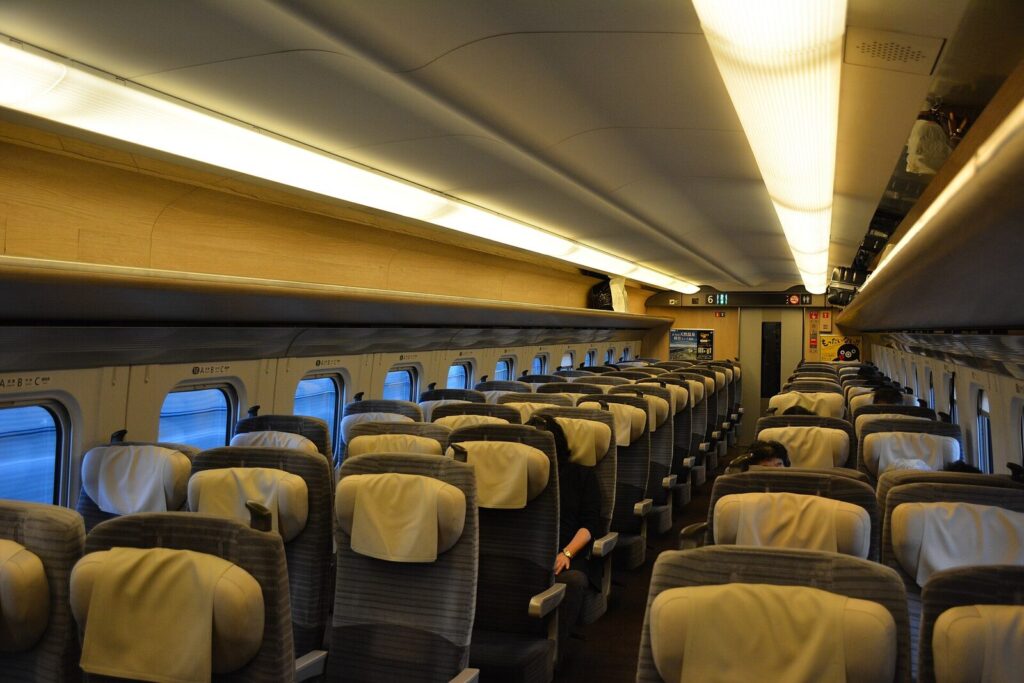
Riding a Shinkansen needs two things: a basic fare ticket and a limited express ticket. JR East’s ticket guide explains that the limited express ticket comes in two forms — a reserved seat ticket with a specifically assigned seat, and a non-reserved seat ticket. With a non-reserved ticket you may only sit in the non-reserved cars.
Non-reserved seating is first-come, first-served. You board any train on your travel date, walk to a non-reserved car, and take whatever is free. If nothing is free, you stand.
On the Tokaido Shinkansen, JR Central lists the typical non-reserved cars as Cars 1–2 on Nozomi, Cars 1–5 on Hikari, and Cars 1–6 plus 13–16 on Kodama, noting these are subject to change. Two non-reserved cars out of sixteen on the busiest service is worth sitting with for a moment — Nozomi is the fast train most visitors want, and it has the thinnest non-reserved allocation on the line.
Which Shinkansen trains have no non-reserved seats at all?
On several named services the choice does not exist. JR East’s ticket guide states plainly that the Narita Express and Shinkansen including the Hayabusa and Kagayaki only have reserved-seat cars, and its route-map pages give the formation details per train.
| Train | Line | Seating per JR East |
|---|---|---|
| Hayabusa | Tohoku / Hokkaido | Reserved seats only |
| Hayate | Tohoku | Reserved seats only |
| Komachi | Akita | Reserved seats only |
| Tsubasa | Yamagata | Reserved seats only |
| Kagayaki | Hokuriku | Reserved seats only |
| Yamabiko, Nasuno | Tohoku | Has non-reserved cars (car numbers vary by train) |
| Hakutaka, Asama | Hokuriku | Has non-reserved cars (car numbers vary by train) |
The practical consequence: if your plan is Tokyo to Sendai, Morioka, Akita, Yamagata or Kanazawa on the fastest service, you are buying a reserved seat. The slower Yamabiko and Hakutaka services keep a non-reserved option, so the real trade on those routes is time against flexibility, not seat type against price.
JR East’s route-map pages also carry a caution worth heeding on the Tohoku and Hokuriku lines: “The cars with reserved and non-reserved seats may vary depending on the train.” Check the platform signage rather than relying on a car number you memorised.
How much more does a reserved Shinkansen seat cost?
The clearest published figures come from smartEX, the official online reservation service run by JR Central, JR West and JR Kyushu. Its price tables are dated 1 April 2025 and were the current tables published on the smartEX site when this article was checked in October 2026. These are smartEX online prices for the Tokaido, Sanyo and Kyushu Shinkansen, not station-counter fares, and they combine the basic fare and the limited express charge into one price.
| Route (one way, adult) | Non-reserved | Reserved, Nozomi, regular season | Difference |
|---|---|---|---|
| Tokyo – Shin-Osaka | ¥13,870 | ¥14,520 | ¥650 |
| Tokyo – Kyoto | ¥13,320 | ¥13,970 | ¥650 |
| Tokyo – Nagoya | ¥10,560 | ¥11,100 | ¥540 |
| Nagoya – Shin-Osaka | ¥5,940 | ¥6,480 | ¥540 |
| Tokyo – Hiroshima | ¥18,380 | ¥19,560 | ¥1,180 |
| Tokyo – Hakata | ¥22,220 | ¥23,610 | ¥1,390 |
| Kyoto – Shin-Osaka | ¥1,450 | ¥2,880 | ¥1,430 |
| Tokyo – Shin-Yokohama | ¥1,380 | ¥2,810 | ¥1,430 |
Prices as of the 1 April 2025 smartEX tables, checked October 2026. Fares change; confirm on the booking screen before you pay.
Read the bottom two rows again. Tokyo to Shin-Osaka is a 2.5-hour ride where reserving adds under 5% to the price. Kyoto to Shin-Osaka is a 15-minute hop where reserving nearly doubles it, because the non-reserved charge for very short Shinkansen sections is discounted and the reserved charge is not.
One more lever on the Tokaido line: taking Hikari or Kodama instead of Nozomi lowers the reserved price slightly. The same smartEX tables list Tokyo to Shin-Osaka reserved at ¥14,200 on Hikari, Sakura, Kodama or Tsubame, against ¥14,520 on Nozomi, as of 1 April 2025. You trade journey time for roughly ¥320 and a far better chance of a free non-reserved seat if you skip the reservation entirely.
How does the season change the reserved seat price?
The reserved price moves with the calendar; the non-reserved price does not. smartEX sets out four tiers — regular, off-peak, peak and top season — and, as published on its service page in October 2026, for one adult the reserved price is ¥200 lower than regular in off-peak, ¥200 higher in peak, and ¥400 higher in top season. For journeys that cross between the Tokaido, Sanyo and Kyushu Shinkansen lines those adjustments double to ¥400, ¥400 and ¥800. The dates for each tier are published on the smartEX calendar page.
So the gap in the table above is a floor, not a ceiling. Applying the top-season adjustment to the 1 April 2025 table, Tokyo to Shin-Osaka reserved works out at about ¥14,920 against an unchanged ¥13,870 non-reserved — a gap closer to ¥1,050. Conversely, an off-peak weekday is the cheapest day to reserve and also the day you are most likely to find a non-reserved seat anyway.
When do Nozomi trains stop selling non-reserved seats?
During designated peak periods, JR Central operates every seat on Nozomi trains on the Tokaido and Sanyo Shinkansen as a reserved seat. Its page states that during the peak periods, Nozomi trains do not have non-reserved seat setting available.
JR Central lists these peak periods for 2026 and early 2027:
- 24 April – 6 May 2026
- 7 August – 16 August 2026
- 18 September – 23 September 2026
- 10 October – 12 October 2026
- 21 November – 23 November 2026
- 25 December 2026 – 5 January 2027
- 9 January – 11 January 2027
- 20 March – 22 March 2027
If you hold a non-reserved limited express ticket during one of those windows, JR Central says you may still board a Nozomi but must stand in the passageway, excluding the Green Cars (Cars 8 to 10). Hikari, Kodama, Mizuho, Sakura and Tsubame keep their non-reserved seats throughout — though JR Central warns those cars may be overcrowded during the same periods.
JR Central also notes that during peak periods the 165 non-reserved seats on Nozomi trains are switched to reserved seats. That is the entire non-reserved capacity of the train moving to the reserved pool, which is why booking early matters more in these windows than at any other time of year.
When does non-reserved genuinely win?
Short solo hops. Kyoto to Shin-Osaka, Tokyo to Shin-Yokohama, Nagoya to Gifu-Hashima: reserving can cost roughly double, for a ride short enough that standing is no hardship.
Off-peak weekday travel when your schedule is loose. A non-reserved ticket lets you board any train on your travel date, so a meeting that runs long costs you nothing.
Boarding at an origin station. At Tokyo or Hakata the train starts empty and you queue on the platform for your pick of seats.
When you are already reserved and running late. JR Central’s guide confirms that if you miss your train, you can board the non-reserved section of any subsequent train that day on the same route, with either a QR ticket or a paper ticket. Your reservation is a floor, not a trap.
When does non-reserved lose?
Boarding mid-route. Joining at Kyoto, Nagoya or Shin-Kobe on a Tokyo-bound Nozomi means two non-reserved cars that filled up an hour earlier. The platform queue at an origin station does not exist for you here.
Groups and families. Non-reserved seating is first-come, first-served, so a party of four is unlikely to find four seats together on a busy service. The extra for a reservation is per person, but so is the alternative of standing separately for three hours.
Oversized luggage. This one is a hard rule, not a preference. JR Central requires anyone bringing baggage with total dimensions over 160 cm onto the Tokaido, Sanyo or Kyushu Shinkansen to reserve a seat with an oversized baggage area, and states that non-reserved cars and some reserved cars do not have these seats. Travelling with such baggage without a reservation incurs a baggage fee of ¥1,000 including tax, as published on JR Central’s luggage page and checked in October 2026. Anything over 250 cm cannot be brought on board at all.
Holiday periods. Covered above — on Nozomi, the option disappears entirely.
Booking from abroad: what you need before you land
Reserved seats go on sale at 10:00 a.m. one month before your departure date, and smartEX allows some products to be booked from 5:30 a.m. one year ahead, with the seat confirmed a month out. Both are online services, so your reservation lives on your phone rather than in your pocket.
That is the connectivity angle on this decision. Changing a smartEX reservation is free and unlimited before departure, and can be done up to four minutes before the train leaves — but only if your phone has working data at the station. If you are relying on airport Wi-Fi alone, you lose the ability to shuffle a booking from a platform. Once aboard the Tokaido Shinkansen, JR Central says free Wi-Fi is available on all its trains.
Frequently asked questions
Can I sit in a reserved car with a non-reserved ticket if it looks empty?
No. JR East’s guide is explicit that a non-reserved seat ticket lets you sit only in non-reserved seat cars. A seat that looks free may be booked from a station further down the line.
What happens if I board a Nozomi with a non-reserved ticket during a peak period?
JR Central says you may board and stand on the deck of an ordinary car, but not sit, and not enter the Green Cars (Cars 8 to 10). It also advises exchanging the ticket for a reserved one beforehand, which can be done once without a fee if you pay the price difference.
Is a reserved seat worth it on the Tokyo–Kyoto run?
At roughly ¥650 extra in the regular season on the smartEX tables dated 1 April 2025 and checked in October 2026, the cost is small relative to the fare, and you are boarding at an origin or near-origin station where non-reserved queues are manageable. The case for reserving strengthens sharply if you are a group, have a large suitcase, or are travelling in one of the listed peak windows.
Does a Japan Rail Pass cover reserved seats?
JR East notes that most passes include the basic fare and limited express charge, and that with a pass alone you can only sit in non-reserved cars unless you also obtain a reserved seat ticket. JR Central adds that the Japan Rail Pass does not cover Nozomi or Mizuho trains, and that boarding a Nozomi with a pass requires paying an additional fee.
Do non-reserved prices change in peak season?
No. smartEX applies its seasonal adjustments to the Ordinary Car reserved seat price. The non-reserved table carries a single set of prices with no seasonal tiers — which is part of why the gap widens on the busiest dates.
The short version
Reserve when the train gives you no choice, when the luggage rule applies, when you are more than two people, or when your date appears on JR Central’s peak list. Go non-reserved on short hops, on quiet weekdays, and when you want the freedom to catch whichever train you reach. On the long Tokaido runs the sums are close enough that comfort, not cost, should decide it.
Show sources
- All seats on Nozomi trains on the Tokaido and Sanyo Shinkansen are reserved seats during the major peak periods — Central Japan Railway Company (JR Central) (accessed 2026-10-16)
- Shinkansen Perfect Guide: Tickets & Tips — Central Japan Railway Company (JR Central) (accessed 2026-10-16)
- Luggage information — Central Japan Railway Company (JR Central) (accessed 2026-10-16)
- smartEX Service — Fare Overview — smartEX (JR Central / JR West / JR Kyushu) (accessed 2026-10-16)
- "smartEX Service" Prices (Reserved Seat in Ordinary Cars), as of April 1, 2025 (PDF) — smartEX (JR Central / JR West / JR Kyushu) (accessed 2026-10-16)
- "smartEX Service" Prices (Non-Reserved Seat in Ordinary Cars), as of April 1, 2025 (PDF) — smartEX (JR Central / JR West / JR Kyushu) (accessed 2026-10-16)
- Set dates for off-peak season, peak season, and the top season — smartEX (JR Central / JR West / JR Kyushu) (accessed 2026-10-16)
- Ticket Overview & Purchasing Guide — East Japan Railway Company (JR East) (accessed 2026-10-16)
- Tohoku Shinkansen — train information and seat reservation by train type — East Japan Railway Company (JR East) (accessed 2026-10-16)
- Hokuriku Shinkansen — train information and seat reservation by train type — East Japan Railway Company (JR East) (accessed 2026-10-16)

Keep reading
Skytree vs Tokyo Tower vs Shibuya Sky: Which View to Pick
Skytree, Tokyo Tower or Shibuya Sky? Ticket prices as of 2026-11, height, indoor or open-air, when to book and the best time…
Japan Ski Lift Passes 2026-27: Niseko vs Hakuba Prices
Niseko United's peak day pass is ¥13,500 and the Hakuba Valley pass is ¥11,100 for 2026-27. Here are multi-day rates, peak dates,…
Is the Hakone Free Pass Worth It? 2026 Costs Compared
Hakone Free Pass vs paying leg by leg: 2026 fares for the train, cable car, ropeway, boat and bus, with five day…