Coin Lockers in Japan: Sizes, Prices and What If Full
What coin lockers in Japan cost by size, whether Suica works, the three-day rule, and exactly what to do when every locker is taken.
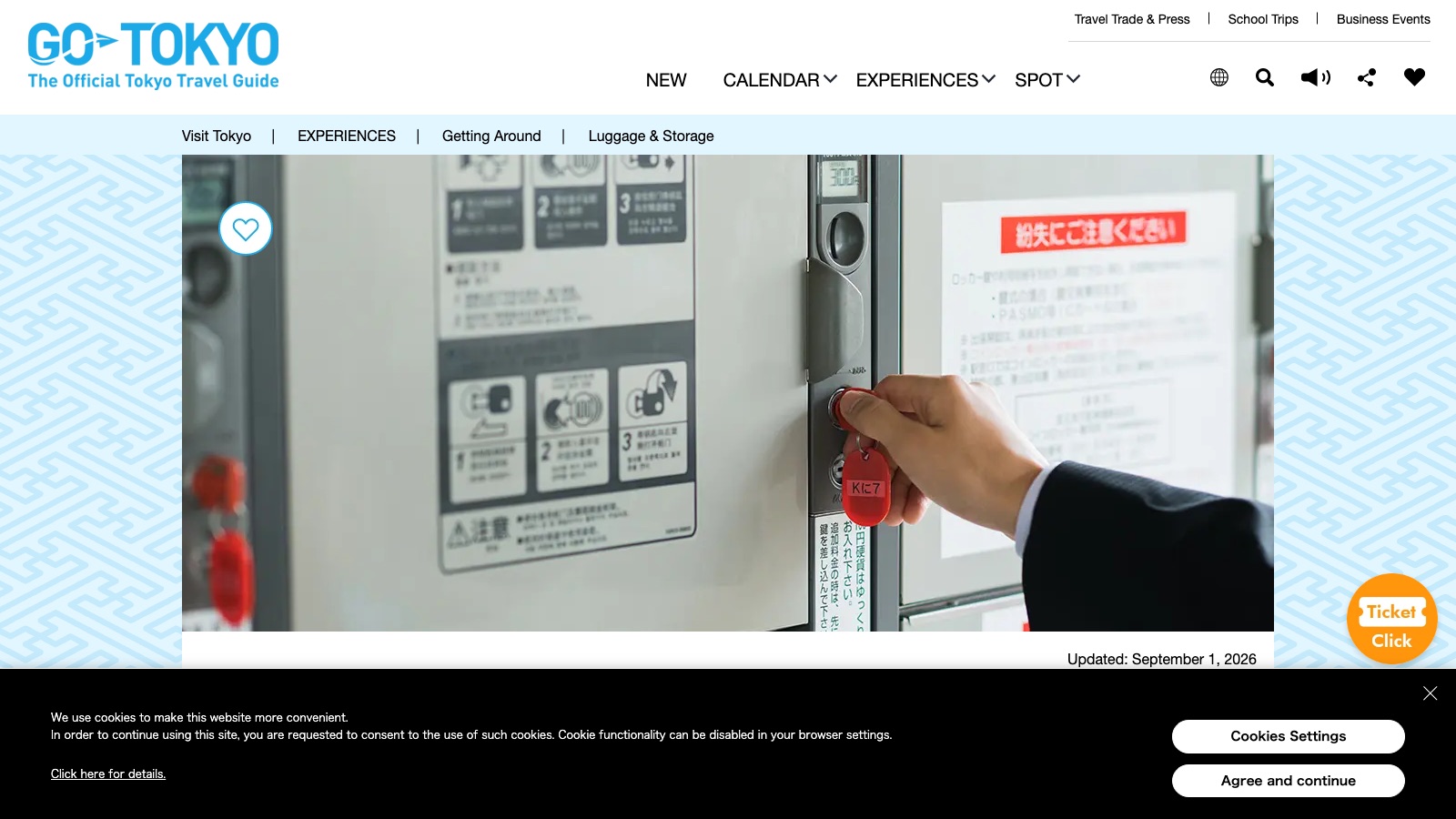
Screenshot: Luggage & Storage — Tokyo Convention & Visitors Bureau (official Tokyo travel site) (accessed 2026-09-30)
On this page
Disclosure Some links on this page are affiliate links. If you buy through them we may earn a small commission at no extra cost to you. It never changes what we recommend.
You step off the train at Kyoto Station at 11:20 with a big suitcase, checkout already done, hotel check-in five hours away. You find the locker bank. Every single door has a light on.
A locker for that suitcase costs ¥900–1,000 for the day. Small bags start at ¥300. Most lockers at big stations now take Suica or PASMO, but plenty of older ones still want ¥100 coins and nothing else.
And if they're all full, the fix is not to keep walking — it's to book a locker or a shop space on your phone, which takes about two minutes.
🧳 How much does a coin locker cost in Japan?
This section gives you the number to budget, per bag, per day.
Prices are set by size, and the same sizes repeat across the country. Here's what JR East publishes for its own lockers at Tokyo terminals, all as of 2026-09:
| Size | What it's meant for | Price per calendar day |
|---|---|---|
| SS | Daypack, tote, shopping bags | ¥300 |
| S | One cabin carry-on | ¥500 |
| M | Carry-on plus souvenir bags | ¥700–800 |
| L | One large check-in suitcase | ¥900–1,000 |
| LL | Oversize case, or two bags | ¥1,000–1,100 |
Tokyo's official travel site quotes a slightly different spread — roughly ¥400–500 small, ¥500–600 medium, ¥700–800 large, and about ¥1,200 for extra-large. JNTO, meanwhile, says to expect ¥300–600.
The official pages genuinely don't agree, because prices vary by operator and by station. Budget ¥500 for a small bag and ¥1,000 for a suitcase and you'll rarely be surprised.
Here's the part people miss: that's a calendar day, not 24 hours. Leave a bag from 9pm to 9am and you pay two days, because the counter ticks over overnight (Keio's published terms apply the extra charge at around 2am). One night in a large locker is therefore ¥1,800–2,000, not ¥900.
📱 Can you pay with Suica, or do you need coins?
Short answer: at any major station, tap your IC card. Away from the big terminals, carry ¥100 coins.
JR East's own station guides list cash and transit IC cards (Suica, PASMO and the regional equivalents) as accepted at Ueno's locker banks, with some units running on IC cards only. Two of the Tokyo Metro banks at the same station go further and take Rakuten Edy, iD, QUICPay, PayPay, Alipay and WeChat Pay.
The newest JR East lockers — branded Multiecube — accept IC cards, QR payments and Visa, JCB, Mastercard and Amex.
But Tokyo's official guide still warns that some lockers accept only ¥100 and ¥500 coins. That's the trap. A ¥900 locker at an older bank means nine ¥100 coins, and no station has a change machine next to the lockers.
One habit worth building: when you break a ¥1,000 note at a konbini, keep the coins. It costs nothing and it solves this.
If you pay by IC card, the card becomes your key. Tap the same card to open it. Don't hand it to your travel partner and walk off in separate directions.
⏳ How long can you leave a bag? The three-day rule
Three days, including the day you put the bag in. That's the standard, and it's written into operators' terms rather than being folklore.
Tokyu's and Keio SC Creation's published locker terms both say the same thing: continuous use is limited to three days from the start date. From day four, staff open the locker and move your things to the operator's designated storage.
From there, they hold it for 30 days counted from the day you started. You pay a storage fee equal to one day's locker rate multiplied by the number of days stored. After 30 days, the terms treat the contents as abandoned and allow disposal.
So a forgotten bag isn't lost — it's retrievable, at a desk, for a fee. Ask at the station office of the line that runs those lockers, not just any station office.
Reserved lockers follow the same ceiling. JR East caps a Multiecube booking at three consecutive days too.
🚫 What to do when every coin locker is full
This is the real question, so here's a ladder. Work down it.
1. Go early, or go one station out. At Shinjuku's East Exit bank, JR East lists 203 lockers — of which 64 are L size. At the South Exit, 76 of 246. Large lockers are the scarce item everywhere, and my read is that this is a checkout-time problem: hotel checkout is 10–11am, so the suitcase-sized doors close between 10am and lunchtime. Drop your bag before 10am and you're competing with almost nobody. Failing that, ride one stop to a quieter station and store it there.
2. Reserve a locker before you travel. JR East's Multiecube lockers can be booked up to a month ahead for ¥500 per box on top of the daily fee, at stations including Tokyo, Shinjuku, Shinagawa, Shibuya, Yokohama, Kyoto and Osaka. A QR code arrives by email early on the day. Honestly, this is the easiest win in this whole article — ¥500 as of 2026-09 to delete the "will there be space?" question from a day you've planned around a temple or a theme park. The catch: same-day bookings close at 9:30am, so you can't rescue an 11am panic with it.
3. Book a shop instead of a locker. ecbo cloak lets you reserve and prepay space in shops, cafés and hotels: ¥500 a day for a bag (longest side under 45cm) and ¥800 a day for a suitcase, tax included, as of 2026-09. Some venues — JR stations among them — charge ¥1,000 per item regardless of size, which is worse value than a large locker. Pick a non-station venue and you're paying less than a locker for a bag that doesn't fit in one. Seven-Eleven now offers the same service out of its back rooms, reservation and payment in advance, with insurance against damage or theft.
An App Store review of the app put the appeal plainly: "This service made travel in Japan so easy. We had a heavy bag that we didn't need to carry around, so we left it for several days." The same reviewer's gripe is worth knowing — extending the booking meant phoning, not tapping. And a more recent review complains that some map pins point at the wrong branch, so check the shop name and address, not just the dot.
4. Use a staffed baggage counter. Kyoto's best-kept fix is Crosta Kyoto, on B1 directly below JR Kyoto Station's central gate: ¥1,000 per item per day, open 8:00–20:00, and it will hold a bag for up to 30 days. Kyoto City's official hands-free page lists more counters around the station, including one at the Hachijo gate. Yamato Transport also runs storage counters at stations and shopping areas with no reservation needed — but you must collect before that counter closes the same day.
5. Let your hotel hold it. Tonight's hotel will almost always take your bag before check-in, and this morning's hotel will hold it after checkout. Free, and nobody thinks to ask.
🚄 When forwarding the bag beats storing it
If you're changing cities, stop thinking about lockers.
Yamato Transport runs same-day delivery between stations, airports and hotels — Kyoto Station into the city is ¥3,470 for a 160-size case, and Haneda into Tokyo's 23 wards ¥5,780, as of 2026-09. Crosta Kyoto is cheaper on short hops: ¥1,500 per item hotel-to-hotel inside Kyoto, or ¥2,500 Kyoto to Osaka.
Compare that with two nights in a large locker plus dragging the case up station stairs. For a hotel-to-hotel move inside one city, ¥1,500 is roughly the price of one and a half locker days, and it removes the bag from your day entirely. That's the trade I'd make.
❓ Quick questions
Do coin lockers take notes?
The newest touch-panel banks accept IC cards, QR payments and credit cards. Older ones take coins — sometimes only ¥100 and ¥500 pieces. Carry a handful.
What if my suitcase doesn't fit any locker?
Book ecbo cloak or a staffed counter. Both accept bags bigger than a locker door, though individual shops can set their own limits.
Can I leave a bag overnight?
Yes, within the three-day limit — but you pay per calendar day, so one night costs two days.
How do I get a bag back after three days?
Contact the station office for the line that operates those lockers. Contents are held for 30 days from your start date, with a storage fee based on the daily rate.
Are lockers really full in Kyoto and Shinjuku?
Large ones, often, from mid-morning in peak seasons — large sizes are a minority of every bank. That's why booking beats searching.
Before you fly
- Budget ¥500 for a small bag, ¥1,000 for a suitcase, per calendar day
- Keep ¥100 coins from your konbini change — older lockers accept nothing else
- Three days maximum, then staff remove the bag to the station office
- Don't hunt for a free door at 11am; book a Multiecube locker or an ecbo cloak shop instead
- Changing cities? Forward the bag and travel empty-handed
Next thing to do: look up the station where you'll need a locker on your first busy day, and reserve one there — remembering that same-day bookings shut at 9:30am, so do it the night before.
Sources
- Luggage & Storage — Tokyo Convention & Visitors Bureau (official Tokyo travel site) (accessed 2026-09-30)
- Luggage & Storage — Japan National Tourism Organization (JNTO) (accessed 2026-09-30)
- コインロッカー使用約款 (Coin locker terms of use) — Tokyu Railways (accessed 2026-09-30)
- コインロッカー使用約款 (Coin locker terms of use) — Keio SC Creation (operates lockers at Keio Line stations) (accessed 2026-09-30)
- 上野駅コインロッカー全19か所解説 (Ueno Station coin lockers) — JR East (accessed 2026-09-30)
- 新宿駅のロッカー情報まとめ (Shinjuku Station locker guide) — JR East (accessed 2026-09-30)
- マルチエキューブなら、空きロッカーの検索・予約・配送が可能 (Multiecube lockers) — JR East (accessed 2026-09-30)
- What is the pricing for ecbo cloak? — ecbo Inc. (accessed 2026-09-30)
- 荷物預かりサービス「ecbo cloak」 (Baggage storage service at 7-Eleven) — Seven-Eleven Japan (accessed 2026-09-30)
- Crosta KYOTO 手荷物預かり・配送 (storage and delivery) — Crosta Kyoto (accessed 2026-09-30)
- Kyoto City Official|HANDS FREE KYOTO — Kyoto City (accessed 2026-09-30)
- Baggage Storage Service — Yamato Transport (accessed 2026-09-30)
- Same-day Delivery Service — Yamato Transport (accessed 2026-09-30)
- ecbo cloak on the App Store (user reviews) — Apple (accessed 2026-09-30)

Keep reading
Coin Lockers in Japan: Sizes, Prices and What If They’re Full
Coin locker sizes and prices in Japan from official railway and airport pages, plus the fallback ladder for when every locker is…
Narita Express vs Skyliner vs Limousine Bus: Which to Book
Skyliner, Narita Express or the limousine bus? Fares, times and luggage compared, then matched to the Tokyo neighbourhood you actually booked.
How Much Cash to Bring to Japan (And Where Cards Fail)
Bring ¥10,000–30,000 for a week and top up at 7-Eleven. Here's exactly where cards work, where they don't, and which ATMs take…