Regional JR Passes That Beat the JR Pass in 2026
The nationwide JR Pass rises to ¥53,000 on 1 October 2026. Here are eight regional passes that cost less and fit the trip you actually booked.
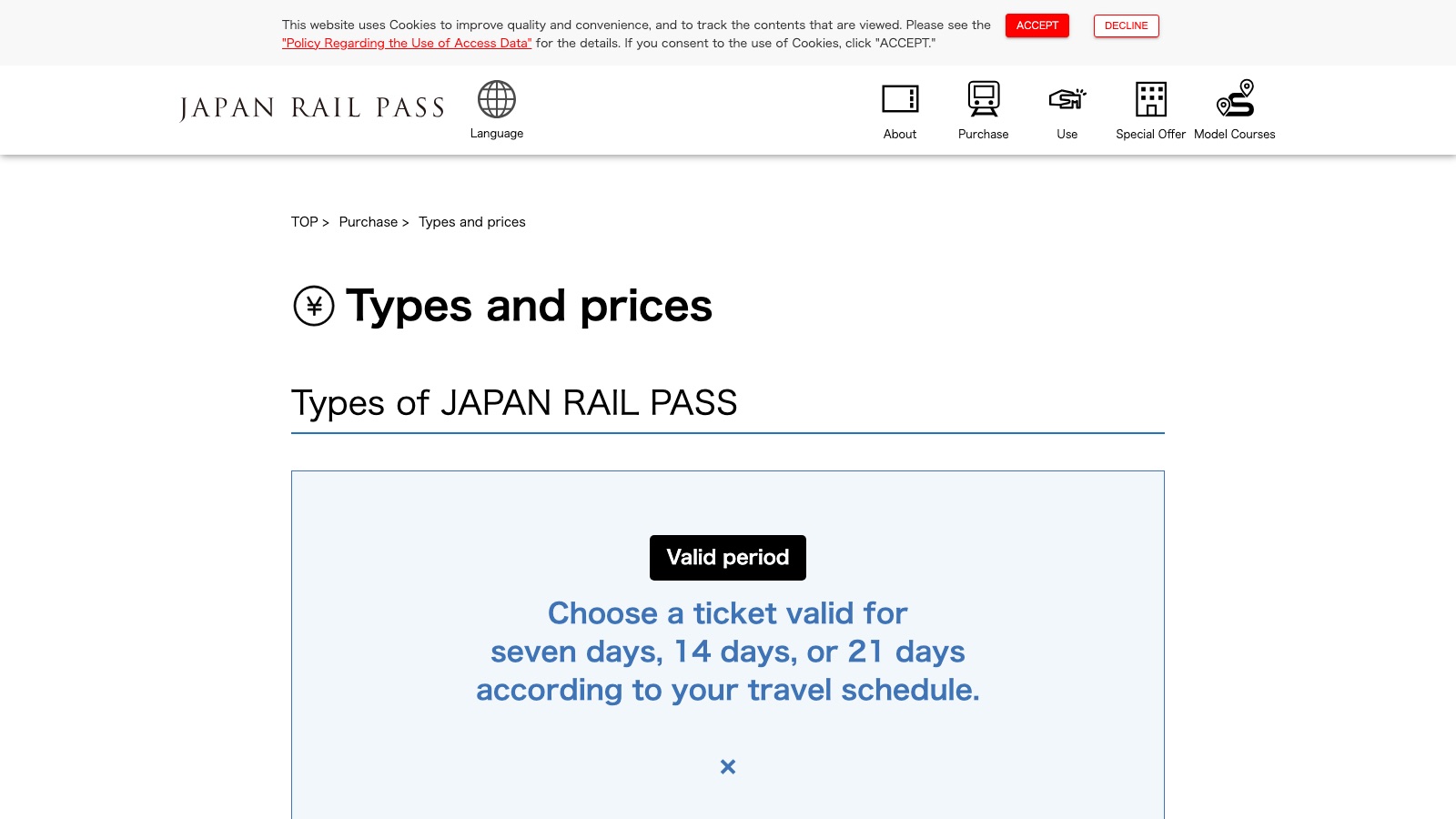
Screenshot: Japan Rail Pass — Types and prices — JR Group (official Japan Rail Pass site) (accessed 2026-09-15)
On this page
- 💸 What you're actually comparing against
- 🚄 The shortlist at a glance
- 🏯 Kansai only: the cheapest useful pass in Japan
- ⛩ Adding Hiroshima and Miyajima
- 🍶 Kanazawa without going near Tokyo
- 🗼 Tokyo in, Osaka out — the northern route
- 🍜 West Japan, all of it
- ❄️ North and east of Tokyo
- 🧮 Check it in five minutes
- ❓ FAQ
- Before you close this tab
- Sources
Disclosure Some links on this page are affiliate links. If you buy through them we may earn a small commission at no extra cost to you. It never changes what we recommend.
On 1 October 2026 the nationwide Japan Rail Pass goes from ¥50,000 to ¥53,000 for seven days. For most two-week first trips, that pass was already the wrong purchase — and a regional pass covering the part of Japan you actually booked will cost you a third of it.
Here's the short version. If your trip is Tokyo–Kyoto–Osaka and back, skip every pass and buy single tickets. If you're staying inside one region, one of the eight passes below almost certainly beats the national one.
Prices below are as of 2026-09 and come from the operators' own pages.
💸 What you're actually comparing against
The nationwide pass is the benchmark, so let's fix the number.
As of 2026-09 the official site lists the 7-day ordinary pass at ¥50,000 for adults and ¥25,000 for children aged 6–11, valid for purchases up to 30 September 2026. From 1 October it becomes ¥53,000 and ¥27,000. The 14-day goes ¥80,000 → ¥84,000, the 21-day ¥100,000 → ¥105,000.
To break even on ¥53,000 in seven days you need roughly a Tokyo–Hakata round trip, or Tokyo–Kyoto twice over with side trips. That's a lot of sitting on trains for a holiday.
Most people don't travel like that. They pick a corner of Japan and dig in. Which is exactly what the regional passes are priced for.
🚄 The shortlist at a glance
Eight passes, all valid for consecutive days from first use. Child prices (ages 6–11) are half the adult price on every pass here. Prices as of 2026-09.
| Pass | Days | Adult | Fast trains it includes | Buy it if your trip is… |
|---|---|---|---|---|
| Kansai Area Pass (WEST QR) | 1–4 | ¥2,700–¥6,700 | No shinkansen; HARUKA airport express | Kyoto + Osaka + Nara, city-hopping |
| Kansai WIDE Area Pass | 5 | ¥12,000 | Shinkansen Shin-Osaka↔Okayama | Kansai base + big day trips |
| Kansai–Hiroshima Area Pass | 5 | ¥17,000 | Shinkansen Shin-Osaka↔Hiroshima, Miyajima ferry | Osaka/Kyoto → Himeji → Hiroshima |
| Kansai–Hokuriku Area Pass | 7 | ¥19,000 | Shin-Osaka↔Okayama, Hokuriku Shinkansen Tsuruga↔Joetsu-Myoko | Kansai + Kanazawa, no Tokyo |
| Sanyo–San'in Northern Kyushu | 7 | ¥26,000 | Sanyo Shinkansen to Hakata, Kyushu Shinkansen to Kumamoto, Nishi-Kyushu Shinkansen to Nagasaki | Osaka → Hiroshima → Fukuoka → Nagasaki |
| JR-WEST All Area Pass | 7 | ¥26,000 | Sanyo Shinkansen to Hakata, Hokuriku Shinkansen Tsuruga↔Joetsu-Myoko | Everything west of Tokyo, no Kyushu deep south |
| Hokuriku Arch Pass | 7 | ¥35,000 | Hokuriku Shinkansen Tsuruga↔Tokyo, Tokyo Monorail | Tokyo in, Osaka out (or reverse), via Kanazawa |
| JR EAST PASS | 5 / 10 | ¥35,000 / ¥50,000 | All JR East shinkansen, reserved seats | Tokyo + Tohoku, or Tokyo + Nagano/Niigata |
One thing that jumps out: the JR-WEST All Area Pass and the Sanyo–San'in Northern Kyushu Pass cost the same ¥26,000 and both run to Hakata. One then turns north to Hokuriku, the other turns south into Kyushu. Pick by where you want to sleep on night four.
🏯 Kansai only: the cheapest useful pass in Japan
You've booked six nights in Kyoto and Osaka with a day in Nara. This is the easiest call on the list.
The WEST QR Kansai Area Pass costs ¥2,700 for one day up to ¥6,700 for four, as of 2026-09, with prices effective from 19 December 2025. It covers ordinary trains, rapid and special rapid services around Osaka, Kyoto, Kobe, Nara, Himeji and Wakayama, plus the HARUKA express from Kansai Airport — non-reserved, with up to two reserved HARUKA seats included. No shinkansen.
The older paper-style Kansai Area Pass runs ¥2,800 to ¥7,000 for the same 1–4 days and includes reserved HARUKA seats. Both are sold; the QR version is a little cheaper.
Honestly, for a Kansai-only week I'd skip both and just use an IC card. The pass wins when your airport transfer plus two long day trips land in the same 2–3 day window.
Go one step up and the picture changes. The Kansai WIDE Area Pass is ¥12,000 for five days, as of 2026-09, and it adds the Sanyo Shinkansen between Shin-Osaka and Okayama plus reach to Kinosaki Onsen, Amanohashidate, Shirahama and Takamatsu. A single Osaka–Okayama round trip on the shinkansen already eats a big chunk of that.
A traveller review on Traveloka sums up the appeal plainly: "Easy to redeem and use. Convenient to go around Kansai area and can use it for Haruka Airport Express as well."
⛩ Adding Hiroshima and Miyajima
Five days, ¥17,000, as of 2026-09. The Kansai–Hiroshima Area Pass stretches the shinkansen coverage from Shin-Osaka all the way to Hiroshima and throws in the JR West Miyajima ferry.
It stops at Hiroshima. Hiroshima→Hakata is not included, so don't plan Fukuoka on this one.
This is the pass for the classic loop: Kyoto, Himeji Castle, Kurashiki, Hiroshima, Miyajima, back to Osaka for your flight. For that itinerary it is comfortably better value than a ¥53,000 national pass you'd only half use.
🍶 Kanazawa without going near Tokyo
Seven days, ¥19,000, as of 2026-09. The Kansai–Hokuriku Area Pass covers Kansai plus Fukui, Ishikawa and Toyama, with reserved seats on the Sanyo Shinkansen to Okayama and the Hokuriku Shinkansen between Tsuruga and Joetsu-Myoko. Thunderbird and HARUKA limited expresses are in.
Kanazawa's gold leaf, Kenrokuen garden, the Kurobe gorge, Kyoto and Osaka — all on one ticket for less than 40% of the national pass.
Travelling only inside Toyama, Ishikawa and Fukui? There's a smaller Hokuriku Area Pass: four days, ¥7,000 as of 2026-09, with non-reserved Hokuriku Shinkansen seats between Tsuruga and Kurobe-Unazukionsen.
🗼 Tokyo in, Osaka out — the northern route
The Hokuriku Arch Pass is the one that makes a full-country trip work without a full-country price. Seven days, ¥35,000 as of 2026-09, with the page marked current as of 28 January 2026. It links Tokyo and Osaka the long way round, via Nagano and Kanazawa, and includes the Tokyo Monorail to Haneda plus HARUKA to Kansai Airport.
The Tokaido Shinkansen is not included. That's the trade: you get Tokyo and Osaka, but the journey between them takes the Sea of Japan route.
My read? At ¥35,000 this is a narrower win than it used to be. It only makes sense if Kanazawa, Toyama or Nagano are genuinely on your list. If you just want Tokyo to Osaka fast, two single Tokaido tickets cost far less than ¥35,000 and get you there in half the time.
🍜 West Japan, all of it
Two seven-day passes at ¥26,000 each, as of 2026-09.
The Sanyo–San'in Northern Kyushu Pass carries you from Kansai down the Sanyo Shinkansen to Hakata, then onward on the Kyushu Shinkansen to Kumamoto and the Nishi-Kyushu Shinkansen to Nagasaki. Fukuoka ramen, Nagasaki harbour, Kumamoto Castle, with Hiroshima and Tottori on the way.
The JR-WEST All Area Pass covers the same Kansai-to-Hakata spine but heads north into Hokuriku instead of south into Kyushu.
There's also a Sanyo–San'in Area Pass at ¥23,000 for seven days. It reaches Hakata but not into Kyushu proper and not into Hokuriku. For ¥3,000 more, the All Area Pass adds Kanazawa and the whole Hokuriku coast — that's the better buy in almost every case.
❄️ North and east of Tokyo
JR East rebuilt its passes on 14 March 2026. The separate Tohoku and Nagano/Niigata passes are gone, merged into one JR EAST PASS: ¥35,000 for five consecutive days or ¥50,000 for ten, as of 2026-09, with children at half price.
It covers every JR East line — Tokyo, all six Tohoku prefectures, Nagano and Niigata — with unlimited reserved seats in ordinary cars on shinkansen, limited express, rapid and local trains.
Two details worth knowing. The old Tohoku pass gave you flexible days within a window; the new one is consecutive, so plan your travel days tightly. And eligibility widened — it's now open to any non-Japanese passport holder, including foreign residents living in Japan.
For a snow trip, a Tohoku onsen run or a Nagano-plus-Niigata week, ¥35,000 for five days of unlimited shinkansen is strong. If you're only doing Tokyo–Nikko–Hakone, it isn't.
🧮 Check it in five minutes
Write down your long-distance journeys, ignoring anything under about ¥1,500. Look up each one-way fare on a route search. Add them up. Compare that total to the pass.
If the pass isn't clearly ahead — say 15% or more — buy singles and keep your flexibility. Passes lock you into consecutive days, and a rainy afternoon in Kyoto can wipe out a travel day you already paid for.
Also check the child fare properly. Every pass here halves for ages 6–11, so a family of four often tips the maths differently from a couple.
❓ FAQ
Can I buy two regional passes for one trip?
Yes. Nothing stops you using, say, a Kansai WIDE pass for five days and a JR EAST PASS later. Two regional passes often beat one national pass on both price and coverage.
Do regional passes include the Nozomi and Mizuho trains?
The JR West passes list reserved seats on Sanyo Shinkansen services within their area; specific train restrictions vary by pass, so check the train list on the official page before you reserve.
Should I buy before the 1 October price rise?
Only if you're certain the nationwide pass is right for you. The price that applies is the one at the moment you buy online or the exchange order is issued — not the date you travel.
Are these passes only for tourists?
Mostly. JR West passes generally require a foreign passport and Temporary Visitor status. The new JR EAST PASS is the exception — it's open to non-Japanese passport holders regardless of visa status.
Where do prices come from?
Every figure here is from the operator's own page. JR West marks several pass pages as current as of 1 August 2024 and notes prices can change, so confirm on the official site before you pay.
Before you close this tab
- The nationwide 7-day pass is ¥50,000 now and ¥53,000 from 1 October 2026 — a high bar to clear
- Staying in Kansai? The ¥12,000 Kansai WIDE Area Pass is the single easiest pass to get value from
- Going west to Kyushu or north to Hokuriku? Both ¥26,000 seven-day options cover more of that trip than the national pass covers of yours
- JR East merged its Tohoku and Nagano/Niigata passes in March 2026 into one ¥35,000 five-day pass — consecutive days now, not flexible
- Two regional passes frequently beat one national pass
Next: open a route search, price the three longest train journeys in your itinerary, and add them up. That number decides everything else.
Sources
- Japan Rail Pass — Types and prices — JR Group (official Japan Rail Pass site) (accessed 2026-09-15)
- Kansai WIDE Area Pass Information — West Japan Railway Company (accessed 2026-09-15)
- Kansai – Hiroshima Area Pass Information — West Japan Railway Company (accessed 2026-09-15)
- Kansai – Hokuriku Area Pass Information — West Japan Railway Company (accessed 2026-09-15)
- Hokuriku Arch Pass Information — West Japan Railway Company (accessed 2026-09-15)
- Sanyo-San’in Northern Kyushu Pass Information — West Japan Railway Company (accessed 2026-09-15)
- JR-WEST All Area Pass Information — West Japan Railway Company (accessed 2026-09-15)
- Kansai Area Pass Information — West Japan Railway Company (accessed 2026-09-15)
- WEST QR Kansai Area Pass — West Japan Railway Company (accessed 2026-09-15)
- Explore More of Japan: Expanded JR EAST PASS Opens Access to the Underexplored Tohoku Region — East Japan Railway Company (press release) (accessed 2026-09-15)
- Price Increases are Coming to the Nationwide Japan Rail Pass (2026) — Japan National Tourism Organization (JNTO) (accessed 2026-09-15)
- JR Kansai WIDE Area Pass — traveller reviews — Traveloka (accessed 2026-09-15)
