What to Pack for Japan in February: Layers, Not a Coat
Tokyo averages 11°C by day and 2°C at night in February, yet trains and shops are hot. Pack layers, not one giant coat. Here's the list.
On this page
Disclosure Some links on this page are affiliate links. If you buy through them we may earn a small commission at no extra cost to you. It never changes what we recommend.
You step onto a Yamanote Line train in your big winter coat, the doors close, and within ninety seconds you are sweating with nowhere to put anything.
That is February in Japan in one scene. Outside it's 3°C, inside it's not, and the single heaviest thing in your suitcase is the thing you can't wear.
So pack layers you can peel. Three thin ones beat one thick one, every day of the trip. And leave room in the bag — the two cheapest fixes for cold in Japan are sold on arrival.
🌡 How cold is Japan in February, really?
Here's the thing most packing lists get wrong: Tokyo and Kyoto in February are cold, but they are not Arctic. The mountains and Hokkaido are a different trip entirely.
These are the Japan Meteorological Agency's 1991–2020 February normals — the 30-year averages for each city.
| City | Average daily high | Average daily low |
|---|---|---|
| Tokyo | 10.9°C | 2.1°C |
| Osaka | 10.5°C | 3.2°C |
| Kyoto | 10.0°C | 1.6°C |
| Takayama (Japan Alps) | 4.7°C | −4.9°C |
| Sapporo (Hokkaido) | 0.4°C | −6.2°C |
Read the Tokyo row again: 10.9°C is a brisk spring afternoon in most of Europe. The 2.1°C low is the 6am version, when you are asleep.
Tokyo's February is also dry and bright — 56.5 mm of rain across the whole month, and 170 hours of sunshine. Compare that to 167.8 mm in June. The Tokyo normal shows about 4 cm of snowfall in February.
Sapporo is the opposite story: 116 cm of snowfall in February alone. If Hokkaido or the Alps are on your route, you are packing for a second climate, and that's the only case where a proper waterproof outer shell earns its space.
🧥 Why one giant coat is the wrong answer
Japanese buildings are legally required to be comfortable. Under the building environmental health standards, large commercial buildings must keep indoor air between 18°C and 28°C — in practice, in winter, that means warm.
Add trains, department stores, restaurants and konbini, and your day looks like this: cold street, hot train, cold street, hot café, cold street. Maybe fifteen transitions before dinner.
A single down parka has one setting. You either wear it or carry it, and carrying it on a packed Kyoto bus is genuinely miserable.
Honestly, this is the whole argument. Not "layers are nicer" — layers are the only system that survives fifteen temperature changes a day without you hauling a duvet around Nishiki Market.
🧦 The layer-by-layer list
Four pieces, worn together on the coldest mornings, stripped back to one on a sunny Kyoto afternoon.
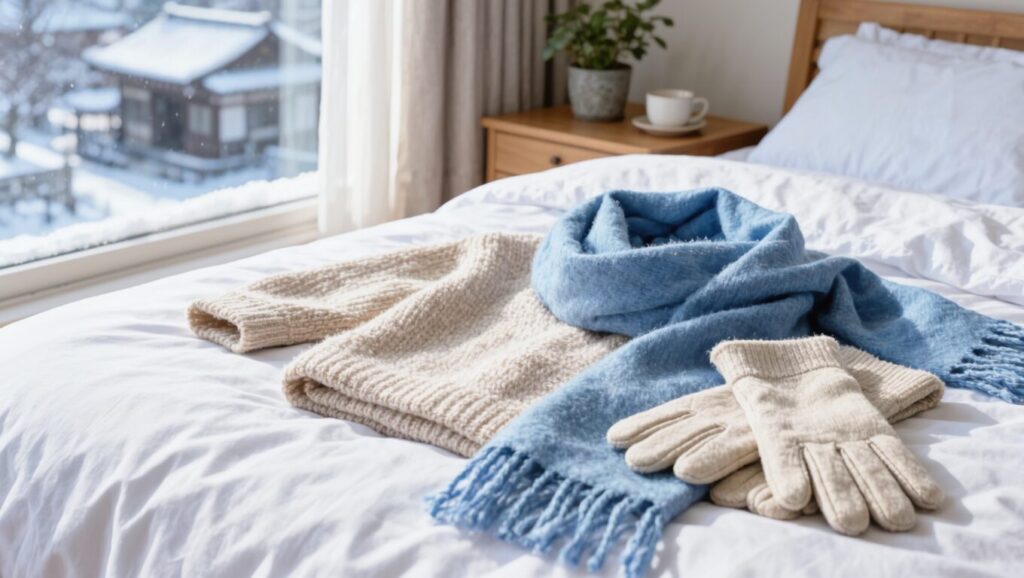
Base layer: merino or thermal, two sets. Thin, worn against the skin, does most of the work. Merino wool is the traveller's pick because it resists smell, so two sets cover two weeks with a sink wash in between.
Mid layer: one fleece or wool jumper. This is your thermostat. Off in the train, on at the temple.
Outer layer: a packable down jacket. The kind that stuffs into its own pocket or a small sack. When the shop is 24°C, it goes in your daypack instead of over your arm.
Bottom half: one pair of normal trousers, plus thermal leggings underneath. Nobody needs snow trousers for Tokyo.
Then the small things that punch above their weight: gloves (you will be holding a phone and an IC card outdoors), a thin neck scarf or buff, and warm socks.
If I had to name the part people get wrong, it's shoes. February in Japan is a walking holiday — you will often hit 15,000 steps a day, temple gravel and station stairs included. Comfortable, closed, already-broken-in shoes matter more than waterproof ones in Tokyo and Kyoto. In Sapporo or Takayama, flip that: grip and waterproofing win.
One more quiet detail. Many temples, ryokan and some restaurants ask you to take your shoes off. Thick socks with no holes are a small dignity.
🍬 Buy it there instead
This is the part that saves you a whole packing cube. Two items are better, cheaper and easier to find in Japan than at home.
Heattech. Uniqlo's thermal innerwear works by absorbing moisture from your body and turning it into heat — and it's sold absolutely everywhere, including inside big stations. Uniqlo has sold a billion HEATTECH items. There are three warmth levels, and the official guidance maps neatly onto the table above:
| Level | Warmth vs regular | Uniqlo's suggested range | Good for |
|---|---|---|---|
| Extra Warm | ~1.5× | −5°C to 15°C | the whole trip, one layer does it |
| Ultra Warm | ~2.25× | −20°C to 10°C | Hokkaido, ski days, Alps |
My read: Extra Warm is the sweet spot for a city trip. Regular is too thin for a 2°C morning, Ultra Warm is too much once you're on a heated train, and Extra Warm's quoted range covers both ends of a Tokyo February day.
Kairo — disposable heat packs. Little sachets of iron powder that warm up when you open them.
They are more powerful than they look. Kowa's high-temperature non-adhesive type runs at an average 63°C and stays above 40°C for about 12 hours. The gentler stick-on version averages 47°C. One in each coat pocket changes an outdoor queue completely.
One practical note: buy them in Japan rather than flying them in — they are inexpensive there.
🧳 What to leave at home
Skip the full-length wool coat. It's heavy, it's slow to dry, and it has no off switch.
Skip snow boots unless you're actually going to snow. Tokyo's February snowfall normal is about 4 cm.
Skip the heavy umbrella — 56.5 mm of rain across a month means the plastic konbini one is plenty if it's needed.
And skip the "just in case" fifth jumper. You're going to a country with excellent, cheap clothing shops in every station.
❓ FAQ
Is February a bad time to visit Japan?
No — it's one of the driest, brightest months in Tokyo, with 170 hours of sunshine and little rain. Crowds are thinner than cherry blossom season, and JNTO notes winter brings many sunny days and blue skies, plus the north's powder snow.
Do I need a winter coat for Japan in February?
You need a warm outer layer, but a packable down jacket plus a mid layer beats one thick coat. With average highs around 11°C in Tokyo and Osaka, the problem is indoor heat, not outdoor cold.
Where do I buy Heattech in Japan?
Uniqlo stores, including branches in and around major stations in Tokyo, Kyoto and Osaka. Check the official store locator for your neighbourhood before you go.
Will it snow in Tokyo or Kyoto?
It's not the norm. Tokyo's February snowfall normal is about 4 cm. Sapporo's is 116 cm — so your answer depends entirely on where you're going.
How cold does Hokkaido get in February?
Sapporo averages 0.4°C by day and −6.2°C at night. That's the one route where Ultra Warm base layers, a waterproof shell and gripped boots are the right call.
The five-second version
- Tokyo, Kyoto and Osaka average 10–11°C by day, 2–3°C at night. Cold, not extreme.
- Buildings are kept between 18°C and 28°C by law, so you'll be hot indoors constantly.
- Pack a thin base layer, a mid layer and a packable down jacket — not one heavy coat.
- Buy Heattech (Extra Warm) and kairo heat packs after you land. Leave the space.
- Going to Hokkaido or the Alps? Pack a second, warmer kit for those days only.
Next: look up the February normals for every city on your route before you pack. If any of them show an average high under 5°C, that's your cue to add the waterproof shell and the proper boots.
Show sources
- 東京 平年値(年・月ごとの値) — Tokyo monthly climate normals — Japan Meteorological Agency (accessed 2026-10-05)
- 京都 平年値(年・月ごとの値) — Kyoto monthly climate normals — Japan Meteorological Agency (accessed 2026-10-05)
- 大阪 平年値(年・月ごとの値) — Osaka monthly climate normals — Japan Meteorological Agency (accessed 2026-10-05)
- 札幌 平年値(年・月ごとの値) — Sapporo monthly climate normals — Japan Meteorological Agency (accessed 2026-10-05)
- 高山 平年値(年・月ごとの値) — Takayama monthly climate normals — Japan Meteorological Agency (accessed 2026-10-05)
- 建築物環境衛生管理基準について — Building environmental health management standards — Ministry of Health, Labour and Welfare (Japan) (accessed 2026-10-05)
- UNIQLO Launches Seamless HEATTECH — 1 billion HEATTECH items over 15 years — Fast Retailing (accessed 2026-10-05)
- ホッカイロ高温 貼らないタイプ — Hokkairo High Temperature, non-adhesive — Kowa Company, Ltd. (accessed 2026-10-05)
- ホッカイロ Hokkairon 貼るレギュラー — Hokkairon stick-on regular — Kowa Company, Ltd. (accessed 2026-10-05)
- Weather in Japan — Japan National Tourism Organization (JNTO) (accessed 2026-10-05)

Keep reading
Vegetarian, Vegan or Allergic in Japan: Eat Without Stress
Dashi hides in dishes that look like vegetables, and restaurants don't have to list allergens. How to read a Japanese food label,…
No Bins in Japan? Where to Throw Rubbish and How to Sort It
Why Japan has so few public bins, where to put your rubbish (konbini, vending machines, your hotel), and a sorting table with…
What to Pack for Japan in Summer: Humidity, Heat and Cooling Gear
Japan's summer is about humidity more than heat. What to wear, how many shirts, rainy-season dates by region, and the cooling gear…