Japanese Manners Locals Care About (and the Myths to Drop)
Japanese surveys show what bothers locals, like loud chat on trains and bags in crowds, and what they don't expect from you, like perfect bows or tips.
On this page
- 🚃 What do Japanese people find most annoying from visitors?
- 🗣 Why is everyone so quiet on Japanese trains?
- 🎒 What should I do with my backpack on a crowded train?
- 🍡 Can I eat while walking in Japan?
- 🙇 Do I need to bow properly, and should I tip?
- ✅ Care / don't care: the cheat sheet
- ❓ FAQ
- 🧳 Recap before you fly
- Sources
Disclosure Some links on this page are affiliate links. If you buy through them we may earn a small commission at no extra cost to you. It never changes what we recommend.
This article contains affiliate links. We may earn a commission at no extra cost to you.
You're on a packed Tokyo train with a big backpack, chatting happily with your friend. Nobody says a word. But in Japan's own surveys, that scene is the thing locals mention most.
The good news is that the list of things locals care about is short. Tips and perfect bows aren't on it.
The short version:
- Keep your voice down on trains. Locals mention this far more than anything else visitors do.
- On crowded trains, hold your bag in front of you or at your feet.
- Don't worry about bow angles or tipping. You aren't expected to get either right.
🚃 What do Japanese people find most annoying from visitors?
The answer comes from a real survey, and it's very clear.
Every year, the Japan Private Railway Association (日本民営鉄道協会, Nihon Minei Tetsudō Kyōkai) asks the public which behaviors in stations and on trains annoy them most. Its 2025 survey ran online from October 1 to November 30, 2025, and got 5,202 answers. People could pick up to three items.
Of those people, 77.1% said they had been bothered at some point by how overseas visitors use the trains. Here is what they named:
| Rank | What bothered people (visitors) | Share |
|---|---|---|
| 1 | Loud talking and horsing around | 69.1% |
| 2 | How bags and umbrellas are carried or placed | 41.9% |
| 3 | How people sit (not shuffling over, legs stretched out) | 26.2% |
| 4 | Strong scents (perfume, fabric softener) | 24.8% |
| 5 | Standing around by the doors | 24.1% |
Look at how far ahead number one is. Nearly seven in ten people picked noise. This was the most useful thing I found while researching this article, because it's one habit you can fix completely, starting today.
🗣 Why is everyone so quiet on Japanese trains?
To many locals, a train is a shared quiet space, a bit like a library you happen to be riding in.
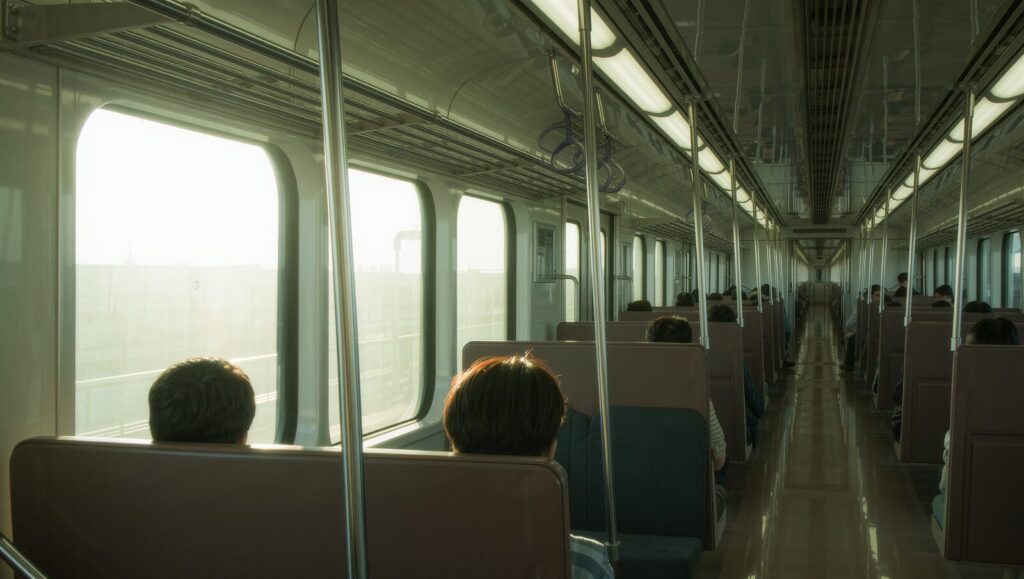
The rail companies say this openly. Tokyu Railways' manners page asks riders to put their phones on silent and not make calls on board ("車内ではマナーモードに設定のうえ、通話はご遠慮ください"). JNTO, the national tourism board, says the same in English: talking on your phone at any volume is "generally frowned upon" on trains and buses.
Here's the part people miss. In the 2025 survey, phone calls and ringtones barely showed up. They got just 6.6% within the smartphone category. That isn't because calls are fine. It's because almost nobody makes them. When you look around a Japanese train, everyone is texting.
So the rule is simple:
- If your phone rings, let it go to voicemail and send a message saying you'll call back.
- If you're in a group, talk at "next to each other in a café" volume, not "across the table" volume.
- If you need to call, step off at the next station. It takes two minutes.
🎒 What should I do with my backpack on a crowded train?
Bags came second on the visitors' list, at 41.9%. And when the survey broke down the bag problems, the single biggest item was wearing a bag on your back, at 27.7%.
The reason is physical. On a rush-hour train, a backpack takes up the space of half a person, and it hits whoever is behind you every time the train moves.
Locals deal with it in one of two ways:
- Swing it to your front and hold it against your chest.
- Put it at your feet or on the rack above the seats.
Tokyu's manners page asks riders to keep their bags from bothering others when the train is crowded. JNTO's responsible travel guide says the same about stowing bags "out of the way of fellow commuters."
Honestly, if you're travelling with a large suitcase, the easiest fix is timing. Riding between about 10:00 and 16:00 instead of rush hour makes everything calmer, for you and for everyone else.
🍡 Can I eat while walking in Japan?
Yes, sometimes. It's less of a hard rule than most English guides make it sound.
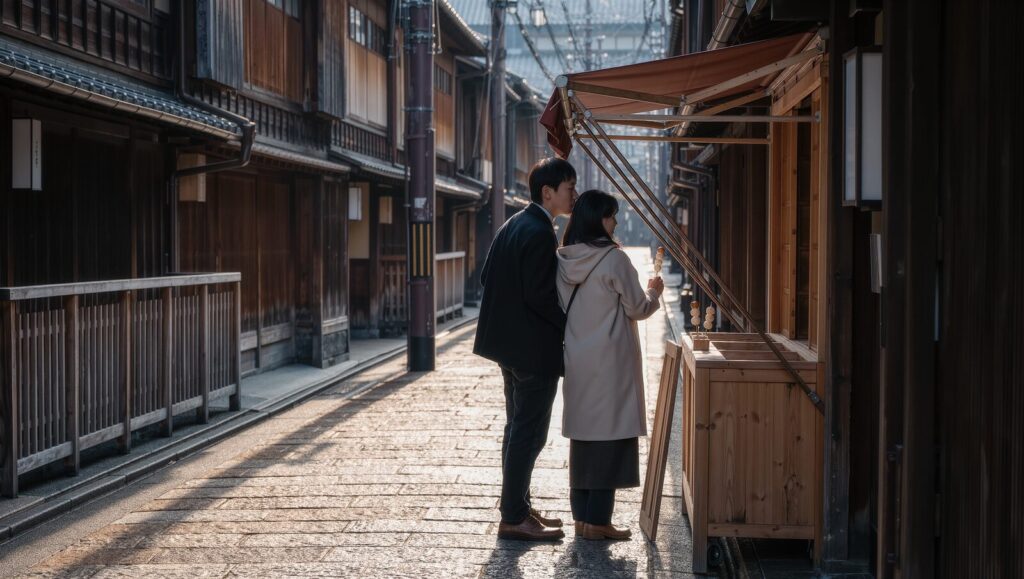
Kamakura, the seaside temple town near Tokyo, is a good example. It's famous for street snacks and gets very busy. In the city's outline for its manners ordinance, the behavior it names is narrow: eating while walking in narrow or crowded places where you could get food on other people's clothes ("他者の衣類を汚す恐れのあるような狭い場所や混雑した場所で、歩行しながら飲食を行うこと"). The same document says the city chose to encourage good manners rather than ban things.
So the local logic is about not dropping soft-serve on a stranger's coat. It isn't about eating in public being shameful.
What that means for you:
- At a food stall, eat standing next to it. That's what the stall is set up for.
- From a convenience store (konbini), eat outside the store or wait until you reach a bench.
- On a crowded train, wait. "Eating and drinking on a crowded train" got 7.5% in the 2025 survey. That's not a big number, but it's on the list.
One more thing. Public bins are rare in Japan. JNTO suggests taking your trash with you when you can't find one, so keep a small bag in your pocket.
🙇 Do I need to bow properly, and should I tip?
No, and no. These are the two things visitors worry about most, and they matter least.
Bowing. JNTO puts it simply: "As a guest in the country, you will more likely be bowed at, rather than expected to bow." It adds that a nod or a small bow of the head when you greet someone, or walk in and out of a shop, "will go a long way." Detailed bowing rules are for very formal situations, and a holiday isn't one.
Tipping. JNTO says tipping is not common in bars, cafés, restaurants, taxis or hotels. Its responsible travel guide adds that a tip "will often be met with confusion." The one exception is a private guide or interpreter, who may accept a tip as thanks. Even then it isn't expected, and it's usually given in an envelope. You can buy small cash envelopes at a convenience store or a 100-yen shop.
My take: you can stop practising your bow and drop the tipping maths. A clear "arigatō gozaimasu" (thank you very much) does more than either one.
✅ Care / don't care: the cheat sheet
| Locals care about this | Locals don't expect this from you |
|---|---|
| Quiet voices on trains | Perfect bow depth and timing |
| Bag in front or at your feet when it's crowded | Tips at restaurants, taxis or hotels |
| No phone calls on board | Slurping your noodles (JNTO: "don't feel obligated") |
| Letting people off before you board | Knowing every rule. JNTO says: "If in doubt, simply ask." |
| Standing still on escalators (JNTO's guidance) | Speaking Japanese |
| Not eating while walking through crowds | Never eating outdoors at all |
| Taking your trash with you | Anything formal at all |
The pattern is easy to spot. Everything on the left is about shared space: how loud you are, how much room you take up, what you leave behind. Everything on the right is about ritual. Locals care much more about the first group.
❓ FAQ
Is it rude to talk at all on Japanese trains?
No. Quiet conversation is normal. The survey's top item is "騒々しい会話" (noisy conversation), not talking itself.
Will I get in trouble if I tip by mistake?
No. The staff may just hand the money back, puzzled. JNTO notes tips are often met with confusion. If you want to say thanks, say it out loud.
Can I use my phone on the train?
Yes, for texting, maps and browsing. Put it on silent. Near priority seats on a crowded train, Tokyu asks riders to switch phones off.
Is eating on the Shinkansen OK?
Yes. The survey's eating item is about crowded commuter trains. On long-distance trains with fold-out tables, eating a bento (boxed meal) is part of the trip.
What if I don't know what to do?
Watch the people around you. JNTO's own tip is to follow the locals, or just ask. Staff are happy to help.
🧳 Recap before you fly
- Noise is the big one. 69.1% of people bothered by visitors on trains named loud talking.
- In crowds, put your backpack on your front or down at your feet.
- Eat beside the stall, not while moving through a crowd, and carry a small bag for your trash.
- Bows and tips are optional extras, not tests.
- Most of these moments happen on trains and in stations, so before you fly, sort out your train tickets or pass and download offline maps and a translation app. Then you can spend the ride looking out the window instead of at your screen.
Book it before you fly

Klook — tickets, tours and rail
- Good forTheme parks, day trips, rail passes
- BookingInstant e-tickets to your phone
- LanguagesEnglish and more

KKday — tickets and experiences
- Good forExperiences, transfers, day tours
- BookingE-tickets and vouchers
- LanguagesEnglish and more
Show sources
- 2025年度 駅と電車内の迷惑行為ランキング | マナーアンケート | 日本民営鉄道協会 — 一般社団法人日本民営鉄道協会 (Japan Private Railway Association) (accessed 2026-10-14)
- マナーアンケート | 日本民営鉄道協会 — 一般社団法人日本民営鉄道協会 (Japan Private Railway Association) (accessed 2026-10-14)
- マナー向上のお願い|東急・東急電鉄公式サイト — 東急電鉄 (Tokyu Railways) (accessed 2026-10-14)
- 「(仮称)鎌倉市観光等マナーの向上に関する条例」素案概要 — 鎌倉市 (Kamakura City) (accessed 2026-10-14)
- Tipping in Japan | Travel Japan | JNTO — Japan National Tourism Organization (accessed 2026-10-14)
- Custom & Manners | Travel Japan | JNTO — Japan National Tourism Organization (accessed 2026-10-14)
- Understanding and Mastering Japanese Manners and Etiquette — Japan National Tourism Organization (accessed 2026-10-14)
- Japanese Customs and Etiquette — Japan National Tourism Organization (accessed 2026-10-14)
- Japanese Manners Do’s and Don’ts — Japan National Tourism Organization (accessed 2026-10-14)

Keep reading
Akihabara vs Nakano Broadway vs Ikebukuro: Anime Shopping Guide
Akihabara for figures and cards, Nakano Broadway for retro finds, Ikebukuro for female-oriented fandom. Here's how to pick, plus the new tax…
Sencha vs Hojicha vs Genmaicha: Japan’s Everyday Teas Explained
Sencha, hojicha or genmaicha? What Japanese people really drink at home, how much caffeine each one has, what 100 g costs and…
Shiroi Koibito vs Royce vs LeTAO: Which to Bring Home
Shiroi Koibito, Royce or LeTAO? Compare price, shelf life, heat, and where to buy in Hokkaido or Tokyo, so the right sweet…