Japan Etiquette That Actually Matters (and What to Skip)
Japan etiquette, sorted: the rules that genuinely matter on trains, escalators and streets, and the ones tourists worry about far too much.
On this page
- What etiquette in Japan actually matters?
- Take your shoes off where shoes come off
- Keep your phone silent and your voice low on trains
- Line up beside the doors and let people off first
- Carry your rubbish until you find a bin
- Obey local smoking ordinances — they are real law, not etiquette
- Respect photography restrictions, especially in Kyoto
- Check whether street drinking is restricted where you are
- What do tourists overthink about Japanese etiquette?
- Bow depth and bowing technique
- Pressing your palms together
- Most chopstick rules
- Tipping, at all
- Eating while walking
- Which side of the escalator should you stand on in Japan?
- So what should you actually do?
- Etiquette that matters vs etiquette that does not: quick table
- How do you handle etiquette you have not read about?
- FAQ
- Will people be offended if I bow incorrectly?
- Can I eat and drink on Japanese trains?
- Is it true that there are no rubbish bins in Japan?
- Should I stand on the left or the right on escalators?
- Do I need to tip anywhere in Japan?
- The short version
- Sources
Disclosure Some links on this page are affiliate links. If you buy through them we may earn a small commission at no extra cost to you. It never changes what we recommend.
Most Japan etiquette lists are far longer than they need to be. The rules that genuinely affect other people are few: take your shoes off where shoes come off, keep your voice and your phone down on trains, carry your rubbish until you find a bin, queue properly, and obey the local smoking and photography rules. Almost everything else on a typical “30 rules” list is either a minor table manner nobody will police or a custom that is quietly being retired.
This guide splits Japanese etiquette into two columns: what actually matters, drawn from official tourism and municipal guidance, and what visitors tend to overthink. Where official sources are vague or disagree, we say so.
What etiquette in Japan actually matters?
These are the behaviours where getting it wrong has a real effect: it inconveniences someone, breaks a local ordinance, or creates a safety risk. They are also the ones official bodies actually write down.
Take your shoes off where shoes come off
The Japan National Tourism Organization (JNTO) states plainly that “in the vast majority of Japanese homes, it is expected that you will take off your shoes.” The same expectation applies at ryokan (traditional inns), where shoes come off at the entrance.
You will not usually have to guess: there is a step up, a shelf of slippers, or a row of other people’s shoes. Temples, tatami restaurants, changing rooms and some museums use the same signal.
Keep your phone silent and your voice low on trains
This is the rule visitors break most often and notice least. JNTO’s manners guidance says that “speaking at any volume on your phone is generally frowned upon while riding trains,” and its Custom & Manners page asks you to “keep it on silent mode and avoid speaking on it” on public transport. A separate JNTO page describes “most public transport banning phone conversation outright.”
Note the wording difference: one page describes a social norm, another describes an outright ban. In practice, operators announce it as a request rather than enforce it as a law, so treat it as a strong norm you should follow rather than something you can be fined for.
Voice calls are the issue, not phone use. Texting, reading, games with headphones and offline maps are all normal. Keep the volume where only you can hear it.
Line up beside the doors and let people off first
JNTO’s guidance is specific: “line up to the side of the train to let passengers disembark before boarding.” Platforms are marked with door positions and queue lines, and at rush hour the queues are the only thing making the system work.
JNTO also asks you to offer priority seating to elderly, pregnant or disabled passengers. If you are sitting in a priority seat and someone who needs it boards, stand up.
Carry your rubbish until you find a bin
Public bins are genuinely scarce. JNTO’s etiquette guide notes that Japan lacks public rubbish bins and that locals take their waste home, while adding that “most train stations and convenience stores have garbage bins.” It also describes the sorting categories you will see: burnables, non-burnables, aluminium cans, and PET bottles.
Kyoto City Tourism Association asks visitors to carry their own trash bag and never litter. A small plastic bag in your day pack solves this for the entire trip.
Obey local smoking ordinances — they are real law, not etiquette
This is the one item on most etiquette lists that carries an actual penalty. Kyoto City Tourism Association states that “Kyoto City ordinances have banned smoking outside of designated areas on all streets of the city,” that the ban covers smoking while walking, standing on the street, and riding a bicycle or motorcycle, and that “persons who smoke in designated non-smoking areas will be fined 1,000 JPY.” As of October 2026 that figure stands at 1,000 JPY, with the designated enforcement zones covering the city centre, the Kyoto Station area, and the Kiyomizu and Gion areas.
Exceptions exist only where ashtrays have been provided by the road or land administrator. Many Japanese cities run comparable ordinances with their own zones and amounts, so check locally.
Respect photography restrictions, especially in Kyoto
Kyoto City Tourism Association notes that photography is prohibited in many parts of Gion, in some areas of shrines and temples, and in some restaurants. It also gives a separate instruction about geiko and maiko: do not stop, touch or follow them, and do not take unauthorized photos or videos of them.
The same page also warns that carving bamboo is criminal property damage and “may result in fines of up to 300,000 yen” — as of October 2026, the figure published on that page. The underlying point is that some things visitors treat as souvenirs or photo opportunities are treated locally as property damage or harassment.
Check whether street drinking is restricted where you are
Shibuya City has an ordinance on securing a safe and secure environment in the area around Shibuya Station. Under the amendment that took effect on 1 October 2024, street drinking in public places such as roads and parks in the designated zone is restricted between 6pm and 5am, year-round rather than only during Halloween and similar periods. The ward’s published material frames this as a request backed by patrols; it does not set out penalty amounts.
Drinking in public is not illegal across Japan, which is exactly why the local exceptions catch people out. A konbini beer on the street is normal in most places and restricted in specific designated zones.
What do tourists overthink about Japanese etiquette?
None of these will ruin anyone’s day, and several are things visitors invent entirely.
Bow depth and bowing technique
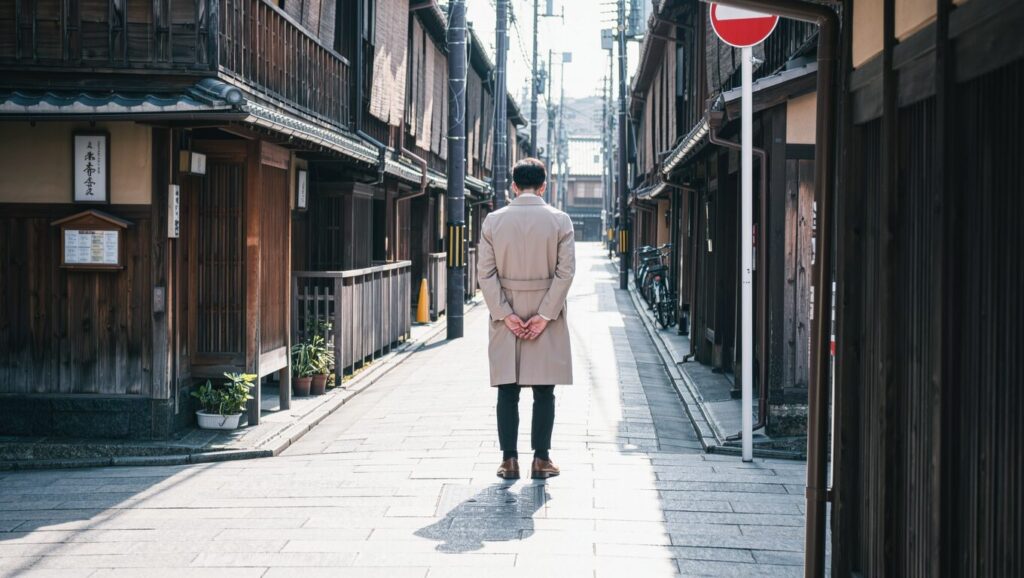
JNTO’s position is reassuringly low-stakes: “in most situations, a polite bow will work as an appropriate greeting,” and “if you’re unsure of someone’s comfort level, simply bowing is usually the safest bet.” Its Custom & Manners page goes further: “As a guest in the country, you will more likely be bowed at, rather than expected to bow.”
There is no angle to memorise. A small nod, repeated often, covers thanks, apology, greeting and goodbye.
Pressing your palms together
Some visitors arrive doing a palms-together bow, usually imported from Thailand or from yoga classes. Pressing your hands together in a shop or restaurant is not offensive, just slightly puzzling. A nod does the job.
Most chopstick rules
Chopstick anxiety is out of proportion to the consequences. JNTO’s written guidance covers a handful of specifics: sushi rice should not be dipped directly in soy sauce, only the fish on top; wasabi should not be mixed into the soy sauce; slurping noodles “is, in general, an accepted practice”; and nigiri sushi is customarily eaten with your hands.
JNTO’s Custom & Manners page adds the most useful line of all: if chopsticks are difficult for you, you can simply ask the staff for a different kind of utensil, though alternatives may not be available in traditional establishments.
Either way, nobody will scold you — put chopsticks flat across the rest or the bowl’s edge and move on.
Tipping, at all
JNTO states that tipping “is not a custom in the first place” and that gratuities are generally not expected. The one adjacent thing to budget for is a seating or late-night charge at izakaya, which is a charge rather than a tip.
Eating while walking
This is usually presented as an absolute ban and is not one. JNTO’s guidance is conditional: “avoid messy foods and lidless drinks, especially in crowded areas,” and step aside from crowds when you eat or drink.
The real-world version: eating a crêpe while walking through a packed Kyoto lane is inconsiderate; drinking from a capped bottle while walking down a quiet street is fine. Many street-food areas expect you to eat standing near the stall.
Which side of the escalator should you stand on in Japan?
Short answer: stand still, hold the handrail, and do not assume one side is a walking lane. The old Tokyo-stand-left and Osaka-stand-right split still describes what you will see, but official guidance has moved against it.
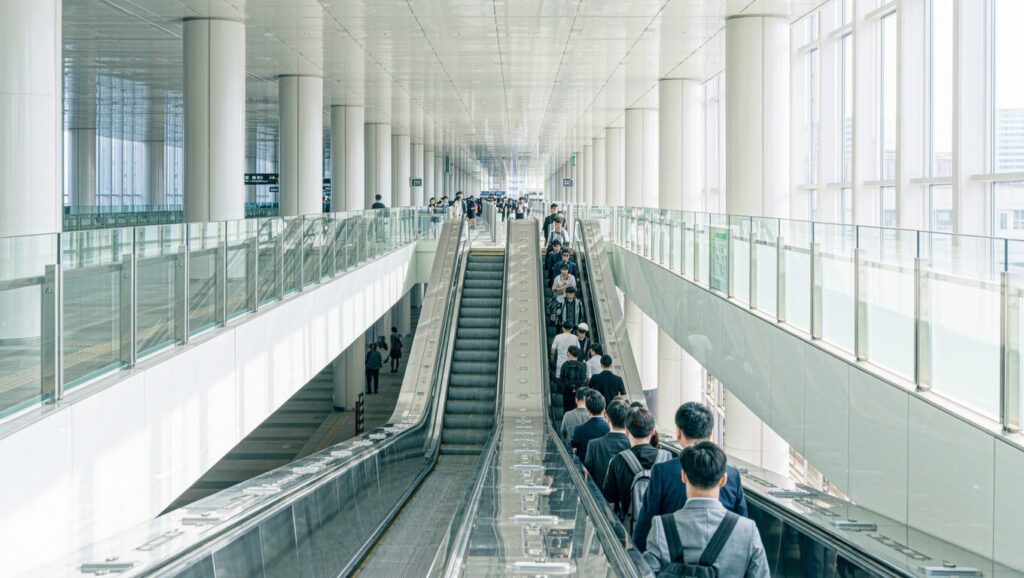
Saitama Prefecture’s Ordinance Concerning Promotion of Safe Escalator Use took effect on 1 October 2021 and requires users to remain stationary while using escalators, with facility managers obliged to inform users of that. Nagoya City’s equivalent ordinance took effect on 1 October 2023 and is explicit that side does not matter: users must stand still on the steps “whether on the right or left side.” Neither prefecture’s nor the city’s published page sets out penalties for users.
The reasoning is a safety one, not a tidiness one. The joint rail-industry campaign release explains that the habit of leaving one side open for walking can lead to dangerous accidents for passengers who can only hold one particular handrail. That campaign, “歩かずに立ち止まろう” (stand still, don’t walk) and “手すりにつかまろう” (hold the handrail), launched in October 2020 with 50 rail operators plus airports, commercial facilities and prefectural governments, endorsed by the Ministry of Land, Infrastructure, Transport and Tourism and the Consumer Affairs Agency. Ibaraki Prefecture’s notice for the current round lists 58 rail operators and seven organisations taking part, with the same two slogans and the same endorsements.
So what should you actually do?
| Situation | What to do |
|---|---|
| Quiet station, nobody behind you | Stand still on either side and hold the handrail. |
| Busy station, everyone standing on one side | Join the standing side. Blocking a moving queue of commuters helps nobody. |
| With luggage or a child | Stand, hold on, keep bags on the step with you, not on the step above. |
| You are in a hurry | Take the stairs. Walking on escalators is what both ordinances and the national campaign ask you not to do. |
Etiquette that matters vs etiquette that does not: quick table
| Behaviour | Matters? | Why |
|---|---|---|
| Shoes off where indicated | Yes | Expected in homes and ryokan (JNTO) |
| No phone calls on trains | Yes | Explicit JNTO guidance; universal norm |
| Queue beside doors, let people off | Yes | Explicit JNTO guidance; keeps rush hour working |
| Carry your rubbish | Yes | Bins are scarce; Kyoto asks visitors to carry a bag |
| Street smoking rules | Yes — legal | Kyoto fine of 1,000 JPY as of October 2026 |
| Photography limits in Gion | Yes | Prohibited in many areas; geiko and maiko off-limits |
| Street drinking zones | Locally | Shibuya Station area restricted 6pm–5am since 1 Oct 2024 |
| Stand still on escalators | Yes | Ordinances in Saitama and Nagoya; national safety campaign |
| Bow at the correct depth | No | A polite bow suffices (JNTO) |
| Palms-together greeting | No — just skip it | A nod or a bow is enough |
| Perfect chopstick handling | Mostly no | You may ask staff for other utensils (JNTO) |
| Tipping correctly | No | “Not a custom in the first place” (JNTO) |
| Never eating while walking | Partly | Guidance is about messy food and crowds, not a ban |
How do you handle etiquette you have not read about?
Watch and copy. Almost every Japanese etiquette question answers itself if you spend ten seconds looking at what the people around you are doing — where they stop, where they put their shoes, which bin they use, whether they are talking.
JNTO’s Custom & Manners page frames the whole subject this way: “show respect for the places you are in and the people who are there.” Kyoto’s responsible travel guidance is similar in spirit, asking visitors to stay quiet in residential and religious areas and to avoid blocking roadways in crowded places.
FAQ
Will people be offended if I bow incorrectly?
Very unlikely. JNTO says a polite bow works as a greeting in most situations and that visitors are more often bowed to than expected to bow. Depth, duration and hand position are not things you need to get right.
Can I eat and drink on Japanese trains?
It depends on the service, and guidance differs between operators, so there is no single national rule. Long-distance shinkansen and limited-express trains have tray tables and bento sold on platforms, while eating on a packed commuter train is impractical and inconsiderate even where nothing forbids it. Capped drinks are the safe default.
Is it true that there are no rubbish bins in Japan?
Scarce rather than absent. JNTO notes that Japan lacks public rubbish bins and that locals take waste home, but also that most train stations and convenience stores have them. Carry a bag and empty it when you pass one.
Should I stand on the left or the right on escalators?
Official guidance now asks you to stand still on either side and hold the handrail, rather than keeping one side clear for walking. Saitama’s ordinance has required standing still since October 2021 and Nagoya’s since October 2023, and Nagoya’s states that side does not matter. In practice crowds still form a standing side, and joining it is sensible.
Do I need to tip anywhere in Japan?
No. JNTO describes tipping as not being a custom in Japan. Izakaya may add a seating or late-night charge, which is a charge on the bill rather than a tip you decide.
The short version
Be quiet on trains, take your shoes off where shoes come off, carry your rubbish, queue properly, stand still on escalators, and check the local rules on smoking, street drinking and photography before you go out. That is the list that affects other people.
The rest — bow angles, chopstick choreography, whether you may sip water while walking — is detail that visitors worry about far more than anyone around them does.
Show sources
- Japanese Manners Do’s and Don’ts — Japan National Tourism Organization (accessed 2026-10-06)
- Custom & Manners — Japan National Tourism Organization (accessed 2026-10-06)
- Japanese Etiquette 101: Eleven Things to Keep in Mind Before Travelling to Japan — Japan National Tourism Organization (accessed 2026-10-06)
- Responsible Travel — Kyoto City Tourism Association (accessed 2026-10-06)
- Smoking on the Street — Kyoto City Tourism Association (accessed 2026-10-06)
- 埼玉県エスカレーターの安全な利用の促進に関する条例 (Ordinance Concerning Promotion of Safe Escalator Use) — Saitama Prefecture (accessed 2026-10-06)
- 名古屋市エスカレーターの安全な利用の促進に関する条例 (Ordinance for Promotion of Safe Escalator Use) — Nagoya City (accessed 2026-10-06)
- 渋谷駅周辺地域の安全で安心な環境の確保に関する条例の一部改正について (Amendment to the Shibuya Station Area Safe Environment Ordinance) — Shibuya City (accessed 2026-10-06)
- エスカレーター「歩かず立ち止まろう」キャンペーンの実施について (Escalator “Stand Still, Don’t Walk” Campaign announcement) — Japan Elevator Association and participating rail operators (accessed 2026-10-06)
- エスカレーター「歩かず立ち止まろう」キャンペーンの実施について (Escalator “Stand Still, Don’t Walk” Campaign notice) — Ibaraki Prefecture (accessed 2026-10-06)

Keep reading
Vegetarian, Vegan or Allergic in Japan: Eat Without Stress
Dashi hides in dishes that look like vegetables, and restaurants don't have to list allergens. How to read a Japanese food label,…
No Bins in Japan? Where to Throw Rubbish and How to Sort It
Why Japan has so few public bins, where to put your rubbish (konbini, vending machines, your hotel), and a sorting table with…
What to Pack for Japan in Summer: Humidity, Heat and Cooling Gear
Japan's summer is about humidity more than heat. What to wear, how many shirts, rainy-season dates by region, and the cooling gear…