Physical SIM Cards in Japan: Where to Buy One in Person, What It Costs, and How Setup Works
If your phone takes a plastic SIM card but not an eSIM, you can still walk into a store in Japan and walk out connected. This guide names the stores, the exact cards on the shelf in 2026, what they cost, the passport situation, and the setup steps.
On this page
- Where you can actually buy one
- The cards themselves, one by one
- IIJmio Japan Travel SIM Unlimited — the walk-in card for heavy use
- IIJmio Japan Travel SIM (classic) — the small, long-lasting card
- b-mobile Visitor SIM — the published-price card, delivered
- eConnect Japan SIM — the big fixed bucket
- Sakura Mobile — the counter with a person attached
- Do you need your passport?
- Setup: the ten minutes after you buy
- When the data runs out
- Before-you-buy checklist
- FAQ
- Sources
Disclosure Some links on this page are affiliate links. If you buy through them we may earn a small commission at no extra cost to you. It never changes what we recommend.
Bottom line first:
- Answer: Yes — you can buy a physical prepaid SIM card in person in Japan, mainly at electronics stores such as BIC Camera, Kojima, Sofmap, and Yodobashi Camera, or order one online for delivery to your hotel.
- Who this is for: Travelers whose phone has a SIM tray but no eSIM support — older phones, many budget and mid-range Android models — and anyone who would rather buy from a person than an app.
- The one caveat: Your phone must be carrier-unlocked, and US-model iPhone 14 and later phones have no SIM tray at all, so a plastic card is not an option for them.
30-second summary
- The walk-in product to look for is IIJmio's Japan Travel SIM, sold at BIC Camera group stores (BIC Camera, Kojima, Sofmap). Its newer Unlimited version runs on au 5G/4G for 10, 15, or 31 days, and the price is set by each store.
- Fixed-amount cards with published prices: b-mobile Visitor SIM, 7GB for 21 days at ¥2,970 (about US$19); eConnect Japan, 50GB for 31 days at ¥5,940 (about US$38); Sakura Mobile's 3GB/day card from ¥3,850 (about US$25). Prices checked October 26, 2026.
- All of these are data-only: no Japanese phone number, no voice calls, no SMS.
- Carry your passport. ID rules for data SIMs are tightening in 2026, and sellers commonly ask for it.
- Setup is usually "insert and go" on iPhone; some Android phones need a one-time APN entry, printed in the package and on the maker's page.
Reading time: about 9 minutes. In a hurry? The table right below is the whole decision. The rest of the page is the evidence, the passport rules, and the setup steps.
The shortlist, at a glance
| Card | Data | Days | Price (checked Oct 26, 2026) | Network | Where you get it |
|---|---|---|---|---|---|
| IIJmio Japan Travel SIM Unlimited | Unlimited (fair-use style limits may apply at busy times; tethering capped) | 10 / 15 / 31 | Set by each store — check the shelf price | au 5G/4G | In person at BIC Camera, Kojima, Sofmap |
| IIJmio Japan Travel SIM (classic) | 3GB | 30 | About ¥2,480 at BIC Camera (retailer-set; varies) | docomo | BIC Camera, Yodobashi, Sofmap, select convenience stores |
| b-mobile Visitor SIM | 7GB | 21 | ¥2,970 (about US$19) | docomo | Ordered online, delivered to your hotel or held at an airport post office |
| eConnect Japan SIM | 50GB | 31 | ¥5,940 (about US$38) | docomo | Ordered online, delivered inside Japan; free shipping |
| Sakura Mobile travel SIM | 3GB per day, then slower | By plan | From ¥3,850 (about US$25) | docomo | Airport counters (Narita, Haneda, Kansai, Fukuoka) or hotel delivery |
How this shortlist was chosen: every card above is a physical, tourist-oriented prepaid SIM that a visitor can obtain inside Japan without a Japanese residence, and every price and specification is taken from the maker's own pages or official guide — or, where the maker does not publish a price, is labelled as retailer-set. No card was given its place in exchange for payment, and the order follows how a traveler meets them — walk-in first, then delivery — not price or commission.
Where you can actually buy one
Three channels sell physical SIMs to visitors: city electronics stores, airport sales points, and online shops that deliver within Japan.
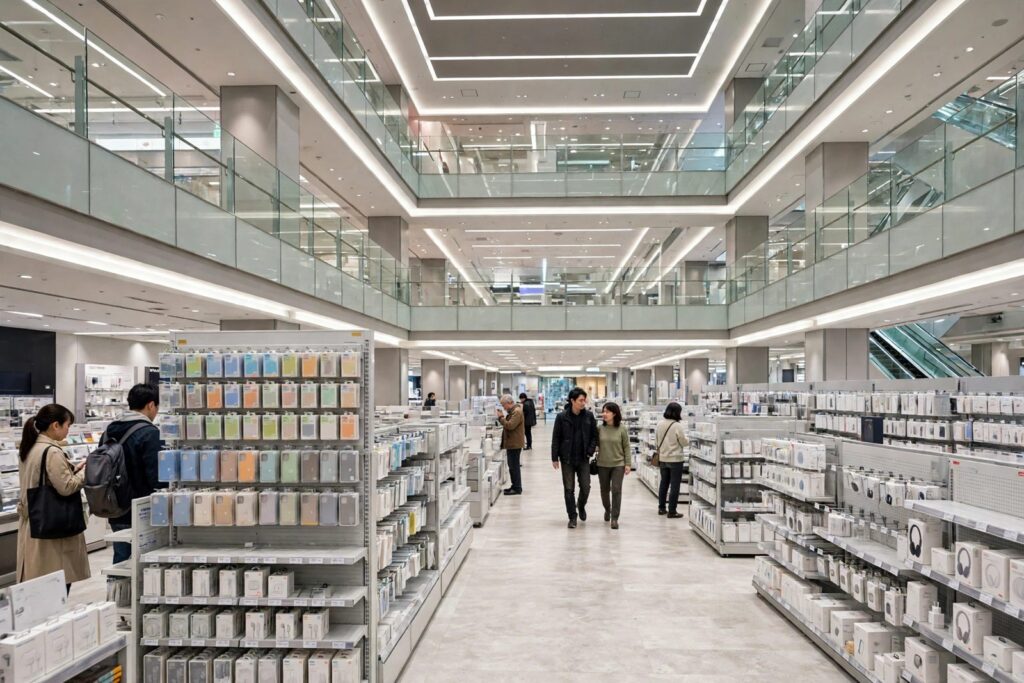
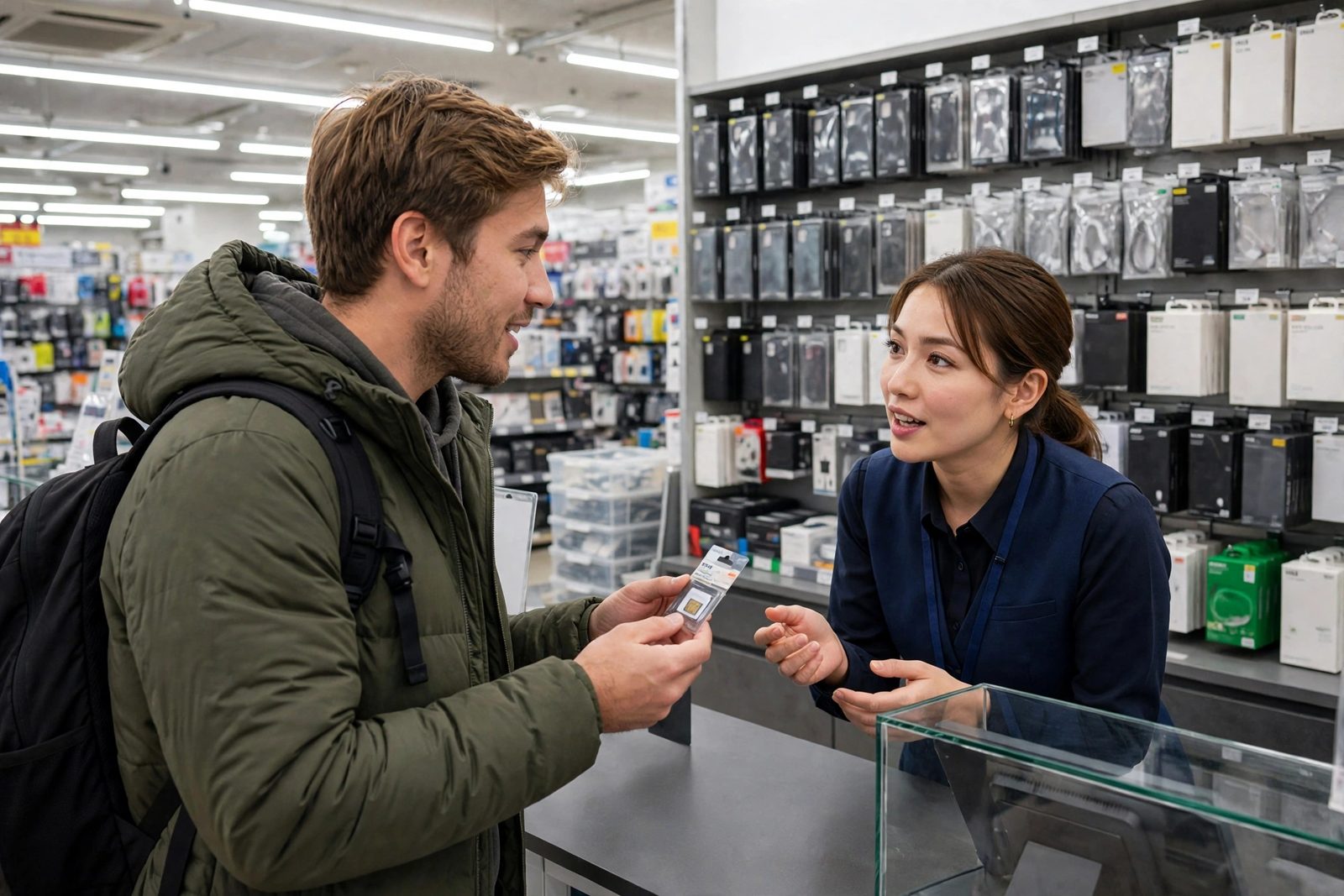
City electronics stores are the main channel. The IIJmio Japan Travel SIM line is built around them: the Unlimited version is sold at BIC Camera, Kojima, and Sofmap storefronts (and those chains' online shops), and the classic card is stocked at BIC Camera, Yodobashi Camera, Sofmap, and select convenience stores. Big-city branches — Shinjuku, Shibuya, Akihabara, Yurakucho in Tokyo, Umeda in Osaka — keep dedicated prepaid SIM corners for visitors. Prices at these stores are the retailer's own, which is why the same card can cost a little more or less from one chain to another.
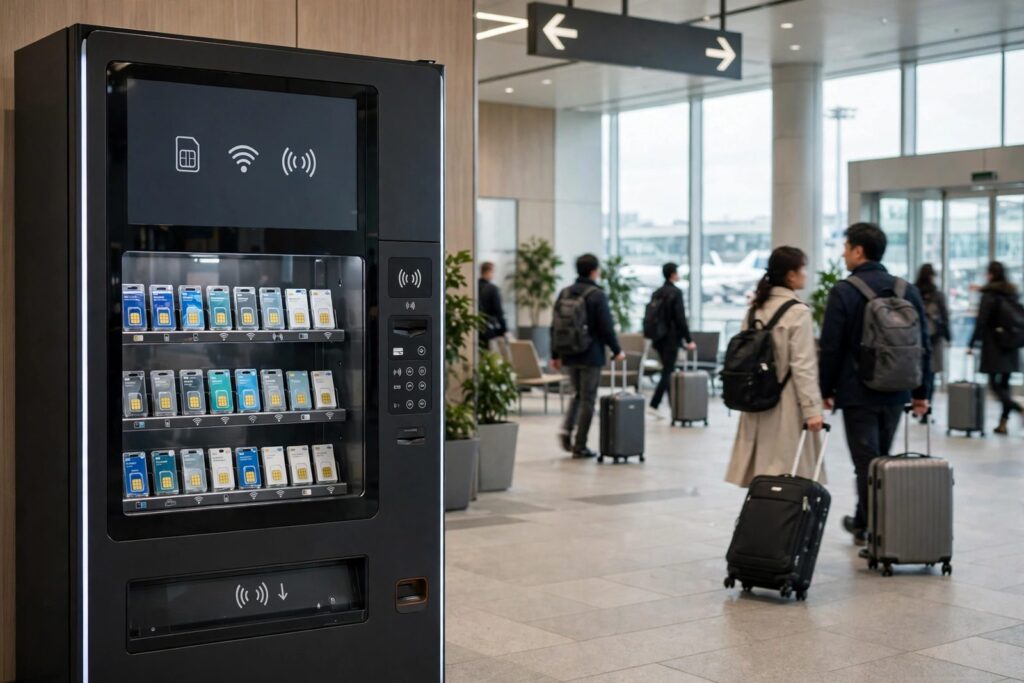
Airports still work, including the store route. BIC Camera runs small branches inside Narita Airport Terminal 2 and Haneda's international terminal, which stock prepaid SIMs — a useful middle ground between a dedicated SIM counter and a trip into the city. Staffed provider counters (Sakura Mobile's, for example, at Narita, Haneda, Kansai, and Fukuoka) can check the card in your phone before you leave. Vending machines cover the hours counters do not, though the choice on a machine is narrower than in a store.
Online delivery is the third channel, and it is Japan-only. b-mobile and eConnect Japan sell physical cards from their websites and deliver to hotels, homes, and airport post offices inside Japan; neither ships overseas. eConnect includes free shipping on SIM cards and says orders typically arrive one to two days ahead of your chosen pickup date — or within one to two days if you are already in Japan. b-mobile charges ¥600 for delivery to a hotel, home, or office, or ¥430 to hold the package at an airport post office (fees in effect since October 2024). If your flight lands late and your hotel is in the city, ordering a card to the hotel the day before you arrive is often the calmest version of this purchase.
| Channel | Choice | Price level | Good to know |
|---|---|---|---|
| City electronics store | Widest (IIJmio line, others) | Retailer-set; tax-free shopping may apply to visitors | Staff can help with setup; you can compare shelf prices on the spot |
| Airport counter or store branch | Narrower | Often a little higher | Staff can test the card in your phone; hours follow the terminal |
| Vending machine | Narrowest | Fixed by machine | Available outside counter hours; no help if setup stalls |
| Online, delivered in Japan | Full web lineup | Published prices | Needs a delivery address and a day or two of lead time |
The cards themselves, one by one
Five products cover most situations; they differ in how the data is counted, not in kind.
IIJmio Japan Travel SIM Unlimited — the walk-in card for heavy use
This is the card BIC Camera group stores were given in 2026: a nano-SIM-only prepaid card with unlimited data on au's 5G and 4G network, in 10-, 15-, and 31-day versions. IIJmio does not publish a price — each retailer sets its own, so the figure that matters is the one on the shelf or the chain's web store. Two conditions come printed with the word "unlimited": speeds may be restricted when the network is congested or traffic is heavy, and tethering has its own high-speed allowances — 9GB on the 10-day plan, 14GB on the 15-day, and 30GB on the 31-day — after which tethered speed drops to a maximum of 128 kbps. Data used on the phone itself has no gigabyte cap. There is no online registration step: on an iPhone you insert the card and it connects, with no APN profile to install; some Android phones need the APN entered once by hand (the official page prints the values, starting with APN uno.au-net.ne.jp). Support is offered in English, Chinese, and Japanese, by phone from 9:00 to 19:00 daily. One firm rule: packages cannot be returned or exchanged, so confirm your phone takes a nano SIM and is unlocked before you pay.
IIJmio Japan Travel SIM (classic) — the small, long-lasting card
The original Japan Travel SIM runs on docomo and is sold in the same stores, plus Yodobashi Camera and select convenience stores. The version most often reported on shelves in 2026 is 3GB over 30 days at about ¥2,480 at BIC Camera — again retailer-set open pricing, so treat that figure as one store's price, checked in May 2026, rather than a national list price. It suits a light-data trip — maps, messaging, translation — better than a streaming-heavy one, and its 30-day window is generous for a small card. If a store offers both versions, the choice is simple: the classic card if 3GB is honestly enough, the Unlimited if it is not.
b-mobile Visitor SIM — the published-price card, delivered
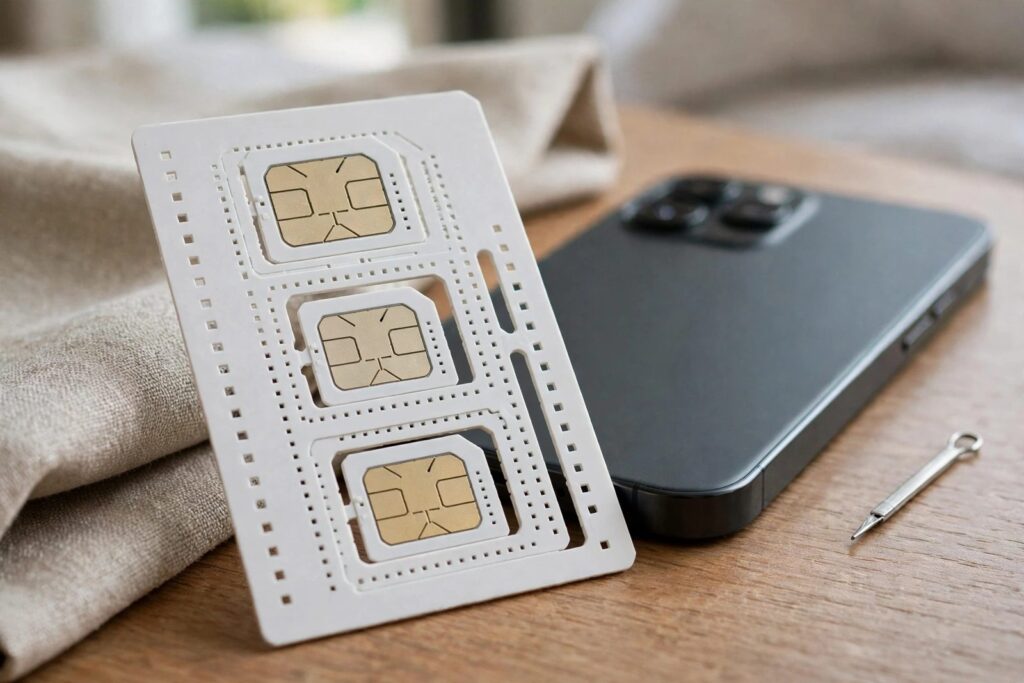
Japan Communications has sold its Visitor SIM to travelers for over a decade. The physical version comes as a multi-cut card (one card punches out to standard, micro, or nano size) on docomo's network, in two sizes: 5GB for 10 days and 7GB for 21 days. The 7GB card is ¥2,970 including tax (about US$19) — a firm published price, which makes planning easy. You order on b-mobile's English website and have it delivered to your hotel or held at an airport post office (offered at major airports, including Narita, Haneda, Kansai, and Fukuoka). Sales are final, with no refunds, and b-mobile offers English email support. Its most useful feature appears later in the trip: if the data runs low, a "Charge" from its website adds 1GB and one extra day for ¥500 — see the top-up table below.
eConnect Japan SIM — the big fixed bucket
eConnect sells two physical cards, 30GB and 50GB, on docomo; the 50GB version runs 31 days and was listed from ¥5,940 (about US$38) when its product pages were checked on August 30, 2026 — confirm the current figure at checkout, as with every price here. The package includes the multi-cut card, a SIM ejector pin, and a setup guide. Tethering is allowed, which makes this card a reasonable single purchase for a couple sharing one phone's hotspot. The trade-offs are structural and worth knowing before you buy: after the allowance is used, speed drops to a maximum of 200 kbps rather than stopping, but data cannot be added and the period cannot be extended. eConnect is online-only — it has no physical stores — and shipping on SIM cards is free.
Sakura Mobile — the counter with a person attached
Sakura Mobile's travel SIMs are sold with staffed support as part of the product: counters at Narita, Haneda, Kansai, and Fukuoka airports (the Kansai Terminal 1 arrivals counter is open 6:00–23:00), delivery to hotels, and an office in Shinjuku for in-person help in English. Its 3GB/day card on docomo starts at ¥3,850 including tax (about US$25) for the physical SIM; each day allows 3GB at full speed before easing to 200 kbps. Its Unlimited plan (on au 5G) is also sold as a physical SIM — shorter plans start in the low ¥4,000 range — with hotspot allowances of 6GB on the 7-day plan, 9GB on the 10-day, and 30GB on the 31-day.
One note on the figures: every price above is the maker's own published number or is marked as retailer-set, checked on October 26, 2026 (the eConnect figure dates from an August 30, 2026 product-page check, as noted in its section). US dollar figures use a reference rate of about ¥157 to the dollar (October 23, 2026) and are approximate.
Do you need your passport?
Carry it. Whether a given data SIM legally requires ID depends on rules that are mid-change in 2026, and sellers commonly ask.
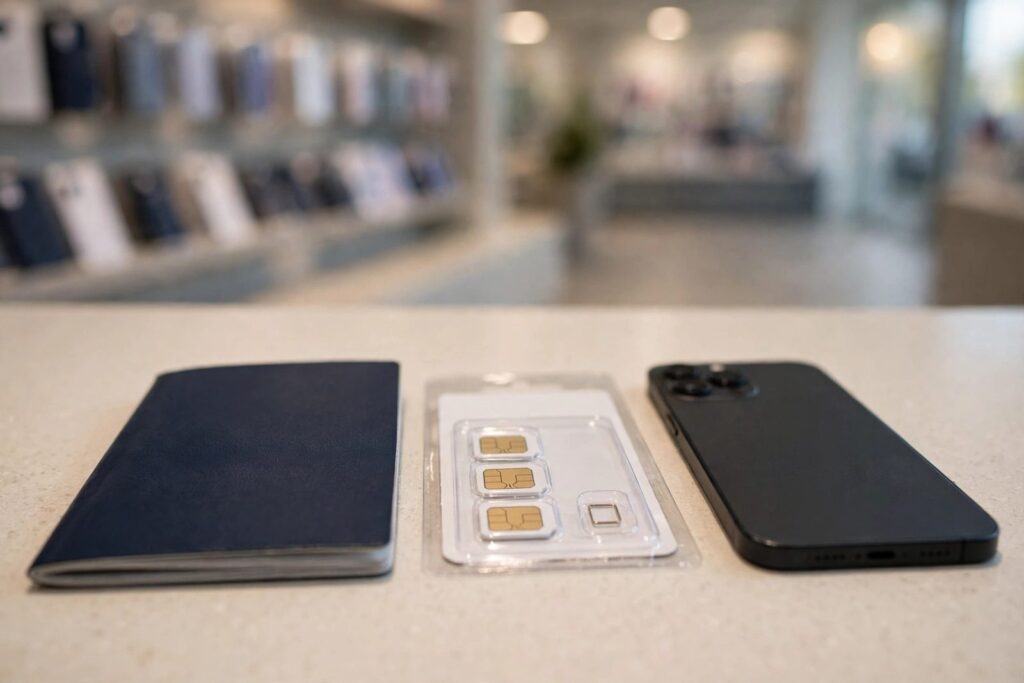
The long-standing rule is clear for voice: since 2006, Japan's Mobile Phone Improper Use Prevention Act has required carriers to verify the identity of anyone taking a SIM that can make voice calls, and for a visitor that ID is a passport. Data-only SIM cards sat outside that law, which is why tourist data cards were historically sold over the counter with no paperwork at all.
That position is shifting. In January 2026, the government announced it had decided to require identity confirmation from buyers of data-only SIM cards as well, as a fraud measure, with an amendment bill to follow. Through 2026, providers and guides have described the timing differently — Sakura Mobile's current FAQ tells customers that passport or residence-card ID has been required for all SIM and eSIM purchases since April 1, 2026, while other careful readings of the ministry's guidance say the April change altered how identity is verified rather than which products are covered. The two readings disagree, and this page will not pretend otherwise.
What that means at an actual counter is simpler than the legal debate: tourist-SIM sellers increasingly build an ID step into the purchase — Sakura Mobile describes the check as happening at airport pickup counters and during online verification. Keep your passport in your hand luggage, not in a checked suitcase, and the question answers itself. One exception in form, not in spirit: IIJmio's Unlimited card has no online registration step at all — you buy the package and insert the card — which makes it the closest thing to the old walk-away experience.
Setup: the ten minutes after you buy
On most phones, setup is: insert card, wait for signal, enter an APN only if the phone asks.
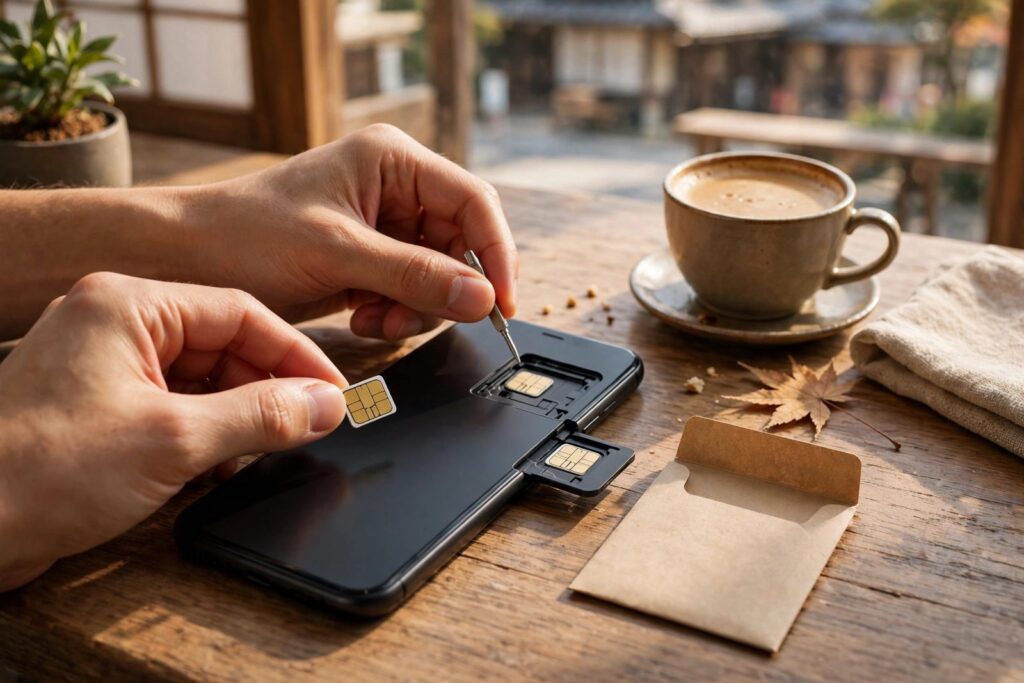
- Check the size before you leave the store. Multi-cut cards (b-mobile, eConnect) punch out to the size you need. The IIJmio Unlimited is nano-SIM only — fine for most phones of the last decade, a problem for very old handsets that take micro or standard cards.
- Power off, swap the card, keep your home SIM somewhere safe. A hotel envelope or your passport wallet works; a loose nano SIM in a jeans pocket is how home SIMs get lost.
- iPhone: on the IIJmio Unlimited, IIJmio states the card works on insertion, with no APN profile to install. If data does not start, check that no leftover configuration profile from another carrier is installed (Settings → General → VPN & Device Management) and remove it.
- Android: many phones connect on their own. If yours does not, add the APN printed in the package — for the IIJmio Unlimited the official page lists APN uno.au-net.ne.jp with CHAP authentication — then restart with WiFi off and confirm a page loads over mobile data. If tethering fails on that card, IIJmio's fix is to add ",dun" to the APN type field.
- Keep the card's backing paper. The PUK code is printed on it, and the package carries the support number and the plan's start rules. Validity on these cards generally counts from first use, not from purchase — b-mobile is explicit that its service start date is the day you begin using the internet — so a card bought on day one is not wasted if you insert it on day two.
Two compatibility checks decide everything, and both are worth doing at home: the phone must be unlocked (a carrier-locked phone will reject every card in this guide), and it must have a SIM tray. US-model iPhones from the iPhone 14 onward are eSIM-only with no tray — if that is your phone, skip this guide and use our comparison of eSIM, pocket WiFi, and SIM options instead (https://travel.dobbo.jp/esim-vs-pocket-wifi-vs-sim-japan/). Coverage and speed, finally, vary by carrier and location on every card here; a docomo-based card and an au-based card will each have buildings, valleys, and tunnels where one does better than the other.
When the data runs out
Each card behaves differently at the end of its allowance — check this before choosing, not after.
| Card | What happens at the limit | Can you add data? |
|---|---|---|
| IIJmio Travel SIM Unlimited | No GB cap on phone data; speeds may be restricted at congested times; tethering slows to max 128 kbps past its allowance (9/14/30GB by plan) | No top-up — the period simply ends |
| b-mobile Visitor SIM | Data stops at 0GB or at the end date | Yes — ¥500 adds 1GB and 1 day, by card, up to 2 days after expiry |
| eConnect Japan SIM | Speed drops to max 200 kbps after the allowance | No — capacity cannot be added, period cannot be extended |
| Sakura Mobile 3GB/day | Each day slows to 200 kbps after 3GB, then resets next day | Extensions handled through its support desk on applicable plans |
Before-you-buy checklist
- Phone unlocked? (Ask your home carrier before you fly — stores in Japan cannot unlock a foreign carrier's phone.)
- SIM tray present, and which size? (US iPhone 14+: no tray. IIJmio Unlimited: nano only.)
- Passport in hand luggage?
- Data shape decided: small fixed bucket (classic IIJmio, b-mobile), big bucket (eConnect 50GB), daily reset (Sakura 3GB/day), or unlimited with tethering caps (IIJmio Unlimited)?
- If ordering delivery: order placed at least a couple of days ahead, addressed to your hotel or an airport post office?
- A way to keep the tiny home SIM safe for the whole trip?
FAQ
Where can I buy a SIM card in Japan besides the airport?
At electronics stores in the city — BIC Camera, Kojima, Sofmap, and Yodobashi Camera are the main ones. The IIJmio Japan Travel SIM line is stocked across those chains, and large branches keep staffed SIM corners. You can also order a physical card online (b-mobile, eConnect Japan) for delivery to a hotel inside Japan.
How much does a physical SIM card cost in Japan?
Published prices run from ¥2,970 for b-mobile's 7GB/21-day card to ¥5,940 for eConnect's 50GB/31-day card, checked October 26, 2026. IIJmio's cards are priced by each retailer instead: the classic 3GB card has been reported at about ¥2,480 at BIC Camera, and the Unlimited card's price is whatever the store sets.
Do I need a passport to buy a data SIM in Japan?
Plan on showing one. Voice SIMs have legally required ID since 2006; data-only cards were exempt, but the government decided in 2026 to extend ID confirmation to them, and tourist-SIM sellers commonly include an ID step now. A passport is the standard document for visitors.
Will a Japanese SIM work in my phone?
If your phone is unlocked and has a SIM tray, in most cases yes. US-model iPhone 14 and later have no tray and cannot take one. Very old phones may also lack the 4G bands Japanese networks use; the IIJmio Unlimited's official page lists its bands (including LTE bands 1, 3, and 28) if you want to check your handset's specifications.
Can I make calls or get a Japanese number with these cards?
No — every card in this guide is data-only, with no voice calls and no SMS. Calls to other app users work over data (WhatsApp, LINE, FaceTime); if you need a dialable Japanese number, that is a different product category — a voice SIM, which requires ID verification by law.
Do I have to return the SIM card when I leave?
No. Tourist prepaid SIMs are yours to keep or throw away. b-mobile states sales are final, and eConnect tells customers to simply toss the card when done. (Pocket WiFi rentals are different — those devices do go back.)
What if I land late at night and the counters are closed?
Use a vending machine at the airport, or have a card waiting at your hotel. BIC Camera's small airport branches follow terminal hours, staffed counters close in the late evening (Sakura Mobile's Kansai counter runs 6:00–23:00), and a hotel-delivered b-mobile or eConnect card removes the timing problem entirely.
To sum up: a phone without eSIM is not a problem in Japan — it just changes where you shop. Decide your data shape, walk into a BIC Camera group store for an IIJmio card or order a b-mobile or eConnect card to your hotel, keep your passport handy and your home SIM safe, and set the APN once if Android asks. Do the unlock check before you fly, and the rest takes about ten minutes at a counter.
Show sources
- Japan Travel SIM Unlimited (PREPAID SIM) — IIJmio (accessed 2026-10-26)
- VISITOR SIM — b-mobile — Japan Communications Inc. (accessed 2026-10-26)
- Charge — b-mobile Visitor SIM — Japan Communications Inc. (accessed 2026-10-26)
- Pocket WiFi Rental & Japan Prepaid SIM You Can Trust — eConnect Japan (accessed 2026-10-26)
- Best Travel SIM Cards for Japan 2026: eSIM vs SIM Compared — Sakura Mobile (accessed 2026-10-26)
- Japanese Govt to Require Confirmation of Identity of Buyers of Data-Only SIM Cards — The Japan News (Yomiuri Shimbun) (accessed 2026-10-26)
- Buying a SIM Card in Tokyo: Tips from Locals — Tokyo Cheapo (accessed 2026-10-26)
- USD to JPY reference rate — Frankfurter (European Central Bank data) (accessed 2026-10-26)

Keep reading

Pocket WiFi Rental in Japan Compared: Japan Wireless, NINJA WiFi, Sakura Mobile, Global WiFi and WiFiBOX
Five Japan pocket WiFi rental services compared on their own published prices: per-day rates, 7- and 30-day totals, data rules, pickup and…
iPhone Low Data Mode in Japan: Save Your eSIM Data for the Day
A practical iPhone checklist for a limited Japan data plan: Low Data Mode, app permissions, usage checks and a hotel backup routine,…
Do You Need LINE in Japan? Registering From Abroad Explained
Do tourists need LINE in Japan? What it is used for, how to register from abroad without a Japanese number, and the…