No Bins in Japan? Where to Throw Rubbish and How to Sort It
Why Japan has so few public bins, where to put your rubbish (konbini, vending machines, your hotel), and a sorting table with the Japanese labels.
On this page
Disclosure Some links on this page are affiliate links. If you buy through them we may earn a small commission at no extra cost to you. It never changes what we recommend.
This article contains affiliate links. We may earn a commission at no extra cost to you.
You finish a bottle of green tea outside Shibuya Station, look around for a bin, and there isn't one. Don't worry: the bottle goes into the recycling box next to the nearest vending machine, and anything else goes in your bag until you reach a konbini (convenience store) or your hotel.
That's really the whole system. The rest of this guide covers why it works this way and how to read the bin labels when you do find one.
The short version:
- Public bins really are rare, mostly for security reasons. That's normal, not a sign you're missing something.
- Drinks bottles and cans go in the boxes beside vending machines. Small rubbish from things you just bought can go in konbini bins.
- Carry one small bag for everything else and empty it at your hotel each night.
🗑 Why are there so few bins in Japan?
The answer goes back to 1995. After the sarin gas attack on the Tokyo subway, many bins were taken out of stations and parks, Stars and Stripes reports. The worry was that a bin is an easy place to hide something.
Bins slowly came back from 2005, often in see-through designs. Then in 2022 they were removed again. Tokyo Metro took them out of 239 locations in January, and the Toei subway removed the ones near its ticket gates in May. The reasons given were safety and people leaving household rubbish in station bins.
So when you see a spotless platform with no bin in sight, that's on purpose. People take their rubbish home.
You won't be the only one surprised. In the Japan Tourism Agency's latest survey, published on 28 April 2026 and based on 4,110 visitors leaving from five major airports, "too few bins" was again the number one hassle. It was named by 17.2% of visitors, ahead of language (15.4%) and crowds (12.9%). The good news is that 43.7% said they had no trouble at all.
🏪 Can I use the bins at a konbini?
Yes, for rubbish from things you bought there. Most Japanese people follow this rule without anyone writing it down.
Konbini bins are there for customers. Store owners have long had people dumping household rubbish in them. Mie Prefecture even ran a scheme in 2015 where 73 of 76 stores in the Ise-Shima area moved their outdoor bins indoors. In 62 of the 64 stores that replied, the amount of rubbish in their bins went down.
So here's the simple version:
- Bought an onigiri and a coffee there? Use their bins for the wrapper and the cup. That's what they're for.
- Carrying a whole day of rubbish from elsewhere? That goes back to your hotel.
You'll often find the bins inside the shop now, near the door or by the coffee machine. They're usually split into several slots, so check the labels (see the table below).
🥤 What do I do with a drink bottle or can?
Drink it at the vending machine, then put the empty bottle or can in the box next to it.
These boxes have an official name, 自販機専用空容器リサイクルボックス (recycling box for empty containers from this vending machine). The drinks industry's message about them is clear: ゴミ箱ではありません、リサイクルボックスです, meaning "this is not a bin, it's a recycling box."
This matters more than people think. The Japan Soft Drink Association says about 30% of what goes into these boxes is other rubbish. That blocks the opening for the bottles they're meant to collect. Since autumn 2022, newer boxes have been orange, with an opening that faces down so only bottles and cans fit easily.
Honestly, this is the habit that makes the biggest difference: finish your drink by the machine. There's a box right there, so you never have to carry an empty bottle. If you walk off with it half full, you'll be holding it for a while.
The same goes for street food. Stalls and shops that sell food to eat on the spot usually have somewhere to leave your stick or paper tray. Eat it there and hand it back.
🧳 Should I carry a rubbish bag?
Yes. It's the best small thing you can pack.
A zip bag or a folded shopping bag in your day bag holds sweet wrappers, tissues and receipts until evening. A USA Today travel writer described doing exactly that: "I carried each day's garbage with me until I returned to my hotel at night." Her verdict: "I didn't find the lack of trash cans in Japan to be a significant problem."
Don't just drop rubbish anywhere, though. Shibuya now gives on-the-spot fines for littering. As of 2026-10, the fine is ¥2,000 and you can pay in cash or by card, according to Business Insider Japan's report on the revised ordinance. The same rules require food and drink businesses around Shibuya, Ebisu and Harajuku to put out bins, so that area should get easier.
♻️ Which bin is which? The labels to match
When you do find a bin, it will usually have several slots. Here's how to match what's in your hand to the Japanese on the bin.
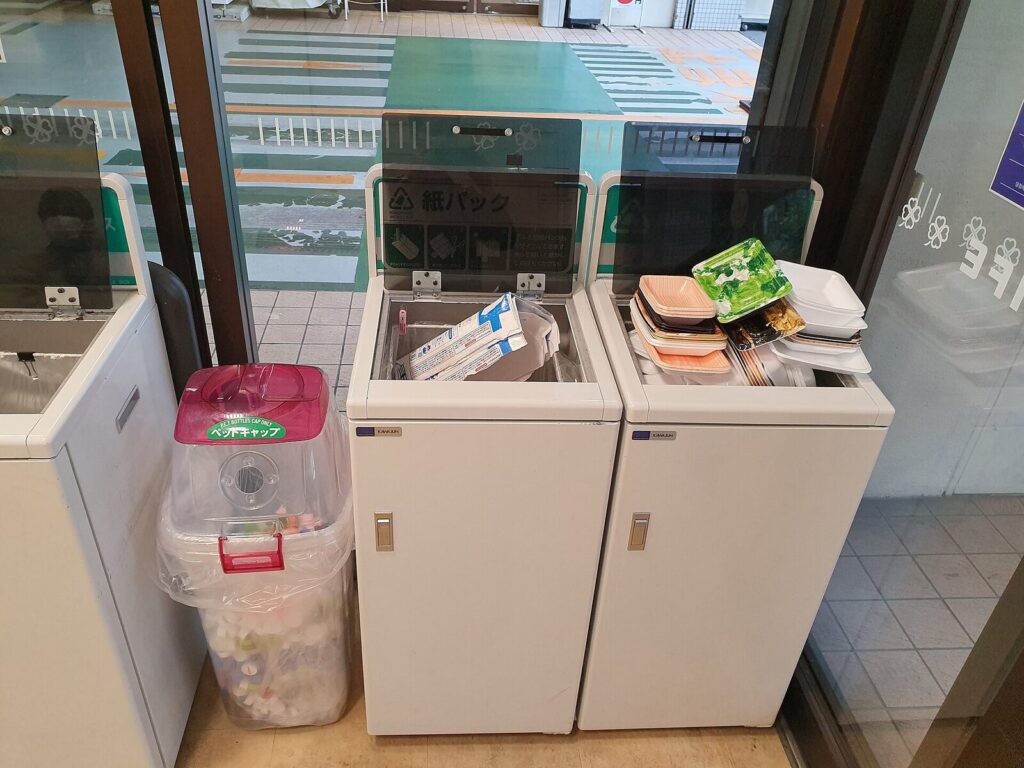
| What you're holding | Label you'll see | Romaji | Notes |
|---|---|---|---|
| Wrappers, tissues, chopsticks, food scraps | 可燃ごみ / 燃えるごみ | kanen gomi / moeru gomi | "Burnable." When in doubt for small, dirty rubbish, this is it |
| Plastic drink bottles | ペットボトル | petto botoru | Empty it. If the bin has a separate slot for caps and labels, put them there |
| Drink cans | 缶 / かん | kan | Aluminium and steel cans both go here |
| Glass bottles | びん | bin | Often shares a slot with cans: かん・びん |
| Clean plastic packaging (trays, bags, cup lids) | プラ / プラスチック | pura / purasuchikku | Only clean plastic. Dirty plastic goes in burnable |
| Things that don't burn (broken items, metal) | 不燃ごみ / 燃えないごみ | funen gomi / moenai gomi | You'll rarely need this as a visitor |
It also helps to look at the packaging. Japan's Ministry of the Environment lists identification marks printed on containers: one for aluminium cans, one for steel cans, a triangle mark for PET drink bottles, and a "プラ" mark for other plastic packaging. If you match the mark on the bottle to the word on the bin, you've got it.
One detail people miss: in Tokyo, the cap and label usually don't go with the bottle. Shinjuku City's 2026 guide says to rinse and crush PET bottles and put caps and labels in recyclable plastic. That's the rule at home, but it's good practice at public bins too.
🏨 What about rubbish in my hotel room?
This part is easy. Your room bin is your main bin for the trip.
Each evening, empty your day bag into it. If the room has more than one bin or a divided bin, follow its labels. They'll use the same words as the table above. If there's only one bin, keep bottles and cans to one side so staff can sort them easily.
Renting an apartment? Then you're living under the local ward's rules, like a resident. Shinjuku, for example, collects burnable rubbish twice a week and most recyclables once a week, put out by 8 a.m. on the right day. Your host's house guide will tell you the days. Read it on your first night.
❓ FAQ
Are there bins at train stations in Japan?
Fewer than you might expect, especially on the Tokyo subway. You'll still find recycling boxes next to station vending machines, and some railways and larger stations do have bins. Bins near shinkansen platforms and inside the trains are worth looking for on long trips.
Can I throw rubbish in a konbini bin without buying anything?
The bins are there for customers, so the polite way is to use them for things you bought there. If you're buying a drink anyway, that covers your wrapper.
Can I put a coffee cup in the vending machine box?
No, those boxes are only for empty bottles and cans from drinks. Cups and food rubbish go in a konbini bin or your bag.
Do I need to remove the label from a PET bottle?
At home in Tokyo, yes: caps and labels go with plastic. At a public bin, use the separate slot if there is one, and otherwise put the empty bottle in the PET slot.
Is littering fined in Japan?
Some areas do it. Shibuya fines litterers ¥2,000 on the spot (as of 2026-10). Carry a bag and you'll never need to think about it.
🎒 Recap
- Japan has few bins because of security decisions made after 1995 and again in 2022, not because they've been forgotten.
- Drink at the vending machine and put the empty bottle or can in the box next to it.
- Use konbini bins for rubbish from what you bought there.
- Match the label: 可燃 (burnable), ペットボトル (PET), かん・びん (cans and bottles), プラ (plastic).
- Before you fly, put a couple of zip bags in your day bag. And while you're packing, add some room for the Japanese snacks you'll want to bring home, so it's sorted before you leave.
Get the taste of Japan sent home

TokyoTreat — Japan-only snacks, monthly
- In the boxJapan-exclusive snacks, a drink and a snack guide
- Ships toWorldwide
- PlanMonthly, a new theme each time

Sakuraco — traditional sweets and tea
- In the box20 Japanese sweets, a tea pairing and a home-goods item
- Ships toWorldwide
- PlanMonthly, a new theme each time
Show sources
- 識別表示マーク(環境ラベル等データベース) — Ministry of the Environment, Japan (accessed 2026-10-29)
- 訪日外国人旅行者の受入環境に関する調査を実施しました(令和8年4月28日) — Japan Tourism Agency (accessed 2026-10-29)
- Living (Information on Everyday Living for Foreign Residents, 2026 edition) – Garbage and Recycling — Shinjuku City (accessed 2026-10-29)
- 自販機専用空容器リサイクルボックス 業界統一仕様の新機能リサイクルボックスを展開(2022年9月29日) — Japan Soft Drink Association / Japan Vending System Manufacturers Association (via Kyodo News PR Wire) (accessed 2026-10-29)
- コンビニエンスストア等の屋外ごみ箱を店内に移設する取組の結果 — Mie Prefecture (accessed 2026-10-29)
- Tokyo trash cans are disappearing from metro and train stations for safety reasons — Stars and Stripes (accessed 2026-10-29)
- 渋谷区のポイ捨て・ごみ箱ルール変更(2025年12月22日) — Business Insider Japan (accessed 2026-10-29)
- The surprising reasons Japan’s streets stay clean without trash cans — USA Today (republished by The Spokesman-Review) (accessed 2026-10-29)

Keep reading
Vegetarian, Vegan or Allergic in Japan: Eat Without Stress
Dashi hides in dishes that look like vegetables, and restaurants don't have to list allergens. How to read a Japanese food label,…
What to Pack for Japan in Summer: Humidity, Heat and Cooling Gear
Japan's summer is about humidity more than heat. What to wear, how many shirts, rainy-season dates by region, and the cooling gear…

Tattoos and Onsen in Japan: Rules, Cover-Ups, Where to Go
No Japanese law bans tattooed bathers. Learn the three tiers of onsen tattoo policy, how big a cover patch really works, and…