Office Omiyage: Japanese Snacks That Survive the Flight
Buying Japanese omiyage for 20 colleagues? Compare boxed snacks by piece count, price and melt risk, plus customs and tax-free rules.
On this page
- Why are Japanese souvenir boxes divided into single servings?
- What makes an omiyage survive a flight?
- Which Japanese snacks survive the flight best?
- How long do these actually keep?
- What will your home country let you bring in?
- Should you buy omiyage at the airport or in town?
- Japan’s tax-free system changes on 1 November 2026
- How to pack omiyage so the boxes arrive flat
- Frequently asked questions
- The short version
- Sources
Disclosure Some links on this page are affiliate links. If you buy through them we may earn a small commission at no extra cost to you. It never changes what we recommend.
If you need omiyage for twenty colleagues, buy dry baked goods or yokan in a box with a high piece count, and skip anything coated in chocolate or filled with fresh cream. A single 15-piece box of a pie-type sweet costs less per person than any chocolate assortment, packs flat, and raises no questions at the customs desk on the way home. The one thing worth checking before you pay is the best-before date printed on the box, because Japanese gift sweets range from under two weeks to a full year.
This guide works through the problem by constraint — individually wrapped, heat-tolerant, shelf-stable, flat-packing — and then covers where to buy, what your home country lets in, and the tax-free rule change landing on 1 November 2026.
Why are Japanese souvenir boxes divided into single servings?
Omiyage is not quite the same thing as a souvenir. It is closer to a social obligation: when you travel, you bring something back for the people who covered for you while you were away. That is why the boxes are built the way they are.
The Japan National Tourism Organization describes the result plainly on its own travel site. Because Japan has a regimented gift-giving culture, it says, you will find rows of perfectly designed gift-wrapped boxes full of sweets, crackers and jellies. JNTO also notes that many Japanese souvenirs are compact, resilient and cleverly packaged, which is exactly the property you want when the gift has to cross an ocean.
The practical consequence for you: a box of 15 individually wrapped pieces is not 15 snacks, it is 15 gifts. Nobody has to cut anything, nobody touches anyone else’s food, and the box can sit in an office kitchen for days without a plate or a knife. That is the whole reason this category exists in the form it does.
What makes an omiyage survive a flight?
Four things, in roughly this order of importance.
Shelf life. Your gift has to survive the trip plus however many days pass before you are back at your desk. A sweet with a two-week best-before date bought on day two of a ten-day trip is already most of the way through its life.
Heat tolerance. Chocolate is the obvious risk. Morinaga states the storage instruction directly on its product pages — one of its chocolate products is labelled 「直射日光を避けて26℃以下で保存してください」, that is, keep it out of direct sunlight and below 26°C. The danger is rarely the flight itself; it is the hours on either side, when a box rides in a bag through a humid afternoon in Tokyo or sits in a hotel room with the air conditioning switched off.
Structure. Thin, crisp items in a shallow box crush. Yokan blocks, dense baked bars and anything in a rigid tin do not.
Packability. Flat rectangular boxes stack against the side of a suitcase. Tall tins and round assortments waste space and end up on top, where they get sat on.
Which Japanese snacks survive the flight best?
The table below compares widely available boxed sweets by the three things that matter for an office run. All prices are tax-inclusive reference retail prices taken from the makers’ own pages as of October 2026; shop prices can differ, and the makers note that some department stores round the tax differently.
| Box | Pieces | Price (tax incl., as of October 2026) | Approx. per piece | Melt risk |
|---|---|---|---|---|
| Tokyo Banana Pie (Mii-tsuketa) | 15 | ¥1,512 | ~¥101 | Low — baked, no coating |
| Tokyo Banana Fermented Butter Rusk | 10 bags | ¥1,458 | ~¥146 | Low — dry baked |
| Tokyo Banana Choco Banana Cookie | 12 | ¥1,620 | ~¥135 | Medium — chocolate in the filling |
| Tokyo Banana Wonder Chocolat | 16 | ¥1,922 | ~¥120 | Medium to high — chocolate |
| Tokyo Banana (banana custard sponge) | 12 | ¥1,944 | ~¥162 | Low heat risk, but short-dated and cream-filled |
| Toraya airport-limited small yokan set | 14 | ¥4,752 | ~¥339 | Very low — shelf-stable bean jelly |
The Tokyo Banana prices above come from Grapestone’s own product pages and from its June 2026 price-revision notice, which took effect on 1 July 2026 for most items and 1 August 2026 for Crispy Milk. The 6-piece Choco Banana Cookie box is ¥842 and the 12-piece Wonder Chocolat is ¥1,458, both as of October 2026, if you need something smaller.
The Toraya set is the premium option and the most robust one. Haneda Airport announced on 8 October 2026 that Toraya’s airport-limited small yokan packaging was renewed from 1 October 2026; the sets are sold in 7, 10 and 14 pieces at ¥2,484, ¥3,456 and ¥4,752 respectively, tax included, as of October 2026. The 7-piece set includes Sky Journey, a white bean jelly sold only at airports, alongside five of Toraya’s standard varieties.
How long do these actually keep?
Yokan is the clear winner here, and Toraya publishes the figure. On its own best-before page the company states 「賞味期限は製造から1年」 — one year from manufacture — and adds that unopened yokan remains edible for a further year past the date: 「未開封であれば賞味期限を超過しても1年はお召しあがりいただけます。」 Once opened, Toraya’s instruction is to reseal the package, keep it at room temperature and eat it soon.
That is unusually generous, and it is why yokan is the low-stress choice if your trip is long or you will not see your colleagues for a week after landing.
For most other boxed sweets, the honest answer is that the figure is on the box, not on the website. Grapestone’s Tokyo Banana product pages list piece counts and prices but do not publish best-before dates or storage instructions online; the pages direct enquiries to the company’s customer line instead. Check the printed date before you buy, especially for the cream-filled sponge, which is the short-dated item in the range.
What will your home country let you bring in?
This is the step people skip, and it is the one that can cost you the whole box at the border. Rules differ by destination, and the two sets below do not line up with each other.
Great Britain. The UK government’s guidance for bringing food in for your own use lists biscuits as unrestricted. It allows bread but not sandwiches filled with meat or dairy products, and allows cakes only without fresh cream. Chocolate and confectionery are allowed except those made with a lot of unprocessed dairy ingredients. Meat, dairy and milk products are restricted and covered by a separate page. Northern Ireland has different rules.
The European Union. The European Commission’s personal-imports page is stricter in what it covers and vaguer in what it permits. Travellers are generally not allowed to bring in meat, milk or their products from outside the EU, with a narrow exception for under 10 kg from the Faroe Islands or Greenland. Notably, that page addresses animal products only — it does not list biscuits, chocolate or cakes at all, so it neither permits nor forbids them in the way the British page does. If you are flying to an EU country, check your national authority rather than assuming the British list applies.
The practical takeaway is the same either way: dry, fully baked, ambient-stable goods are the low-friction choice, and anything built around fresh cream or a large share of unprocessed dairy is the one to leave behind.
Should you buy omiyage at the airport or in town?
Buy in town if you want range and a calmer decision. Buy at the airport if you do not want to carry boxes around for a week, which JNTO itself suggests — its guide calls the airport an ideal place to purchase souvenirs for friends and family without having to carry them around, and points visitors to Narita Terminal 1 for shops specialising in Japanese confectionery, tea and lacquerware.
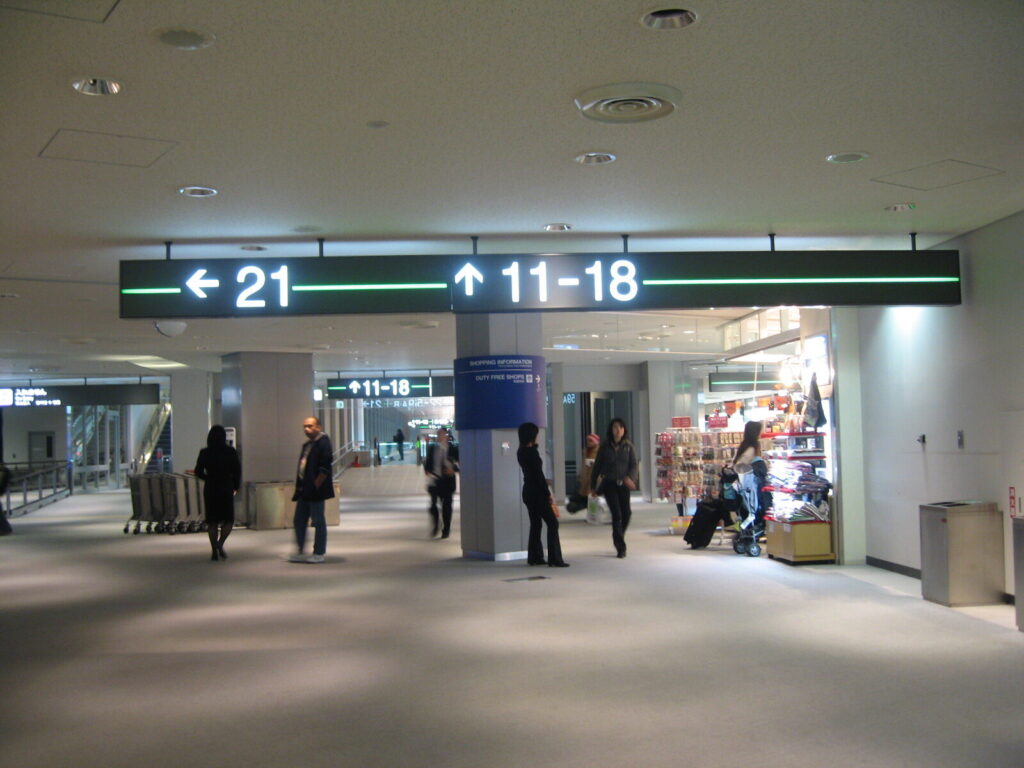
One detail matters more than price: whether the shop is before or after the security check. Narita Airport’s own shopping pages describe its featured international malls as T1 Airside, T2 Airside and T3 Airside, and tell you to shop from after the security check to boarding. Haneda’s shop search has an explicit filter for shops before the security check and after the security check, so you can confirm a specific store’s side before you commit to a plan.
Why it matters: if you buy landside, you carry the boxes through screening yourself. If you buy airside, you have less time and fewer shops, but nothing to re-pack. Haneda lists the Toraya yokan sets in both kinds of location — Terminal 1 stores such as PIER 1 and CAPTAINS’ MARKET, Terminal 2’s Tokyo Food Hall, and Terminal 3’s Edo Food Hall and the TIAT Duty Free Shop Central — though the airport notes the selling stores may change.
Japan’s tax-free system changes on 1 November 2026
If your trip falls near that date, this affects how you pay. According to JNTO, from 1 November 2026 travellers will pay the full tax-inclusive price at the register and claim the consumption tax back at departure, instead of having it deducted in store. The threshold stays at 5,000 yen or more per tax-free shop per day, before tax.
Two changes help omiyage buyers specifically. First, JNTO states that the special sealed packaging previously required for consumable items such as food, drinks and cosmetics will no longer be required, so you will not be handed a taped-shut bag you are not allowed to open. Second, the refund is processed after a customs inspection, which must be completed before check-in and within 90 days of purchase; a green result means no inspection is needed, and a red result means taking the purchases to the customs inspection area.
Japan Customs sets out the obligation on its own passenger page: you are required to export the tax-free goods, you present your passport to Customs on departure, and Customs may check that you still have the goods. If you do not take them out of Japan you pay the consumption tax at Customs, and transferring tax-free goods before departure carries a penalty of up to one year’s imprisonment or a fine of up to 500,000 yen. In plain terms: do not hand out your tax-free omiyage to people in Japan, and do not eat it on the trip.
How to pack omiyage so the boxes arrive flat
A few habits that cost nothing:
- Buy last, pack first. Boxes go in on the final repack, flat against the back panel of the case, with clothes on top rather than underneath.
- Keep the maker’s box. It is structural. Removing the outer sleeve to save space usually costs you more in crushed corners than it gains.
- Keep chocolate out of the sun. If a maker prints a storage ceiling — Morinaga’s instruction on the product checked here is below 26°C — treat an un-air-conditioned car or a sunny hotel windowsill as the real hazard, not the aircraft.
- Carry one box in your cabin bag. If a suitcase goes missing, you still arrive with something.
- Photograph the best-before date when you buy, so you can plan the office handout without opening the box.
Frequently asked questions
How many pieces do I need for an office of 20?
One 15-piece box plus a smaller 6-piece box covers 21 people with one spare. Two 12-piece boxes also work and give you a choice of flavour. Buying a single large assortment is usually more expensive per head than two mid-size boxes.
Is chocolate a bad idea?
Not automatically, but it carries the most risk and the most rules. Morinaga’s labelling asks for storage below 26°C out of direct sunlight on the product checked here, and the British guidance excludes confectionery made with a lot of unprocessed dairy. A baked pie or rusk avoids both issues.
Will the cream-filled sponge cakes survive a long-haul flight?
They are short-dated and cream-filled, which makes them the weakest candidate in this category for a long trip. Great Britain’s guidance allows cakes only without fresh cream, so for a UK-bound office run the baked and dry items are the safer pick.
Do I still get tax-free shopping after 1 November 2026?
Yes, but as a refund rather than a discount at the till. JNTO states you pay the tax-inclusive price in store and claim the consumption tax back at departure after a customs inspection, with the same 5,000 yen per shop, per day minimum before tax.
Is it cheaper to buy in town than at the airport?
Not reliably. The makers publish reference retail prices rather than location-specific ones, and some items — such as Toraya’s Sky Journey yokan and Tokyo Banana’s Narita-exclusive chocolate banana cake — are sold only at airports, so there is no in-town equivalent to compare. Treat the airport as a convenience choice, not a bargain.
The short version
For an office of twenty, a 15-piece baked box is the efficient core of the gift, yokan is the option that will keep no matter how long your trip runs, and chocolate is the one that needs thought about heat and about your destination’s dairy rules. Check the best-before date on the box before you pay, and if you are travelling on or after 1 November 2026, budget for paying the tax up front and claiming it back at the airport.
Show sources
- 東京ばな奈パイ「見ぃつけたっ」 product page — Grapestone / Tokyo Banana (accessed 2026-10-22)
- 東京ばな奈のチョコバナナクッキー product page — Grapestone / Tokyo Banana (accessed 2026-10-22)
- 東京ばな奈「見ぃつけたっ」 product page — Grapestone / Tokyo Banana (accessed 2026-10-22)
- 価格改定のお知らせ (price revision notice, effective 1 July / 1 August 2026) — Grapestone (accessed 2026-10-22)
- 羊羹の賞味期限 (yokan best-before and storage) — Toraya (accessed 2026-10-22)
- Toraya’s “Airport Limited Edition Small Yokan” Package Renewal — Haneda Airport (accessed 2026-10-22)
- Shops search (before / after security check filter) — Haneda Airport (accessed 2026-10-22)
- Shopping at Narita Airport — Narita International Airport (accessed 2026-10-22)
- カカオの力ピーナッツチョコレート product page (storage below 26°C) — Morinaga & Co. (accessed 2026-10-22)
- Bringing food, animals or plants into Great Britain — GOV.UK (accessed 2026-10-22)
- Personal imports of products of animal origin — European Commission (accessed 2026-10-22)
- Everything You Need to Know: Japan’s New Tax-Free Shopping System — Japan National Tourism Organization (accessed 2026-10-22)
- Last-Minute Souvenirs — Japan National Tourism Organization (accessed 2026-10-22)
- Guide for Passengers / tax-free goods on departure — Japan Customs (accessed 2026-10-22)

Keep reading
Shipping Japan Shopping Home: EMS, Surface Mail and Costs
What it costs to mail a box home from Japan by EMS, air, SAL or surface mail as of October 2026, plus…
Buying Matcha in Japan: Purchase Limits and Where to Find It
Matcha purchase limits in Japan are set shop by shop. Current prices, where to buy in Kyoto and Uji, and the 1…
Daiso vs Seria vs Can Do: Japan 100-Yen Shop Haul Guide
Daiso, Seria or Can Do? Store counts, why a 100-yen item costs 110 yen, and how Japan's 1 November 2026 tax-free refund…