Do You Need a Plug Adapter for Japan? Voltage and Sockets
Japan runs on 100V with two flat pins. US plugs fit, UK, EU and Australian plugs need an adapter, and your hairdryer is the real problem.
On this page
Disclosure Some links on this page are affiliate links. If you buy through them we may earn a small commission at no extra cost to you. It never changes what we recommend.
You're packing, and there's a drawer of adapters in front of you. Which one goes in the bag?
Japan runs on 100 volts AC, with sockets that take two flat parallel pins. If you're coming from the US, Canada or Mexico, your plugs already fit and you don't need an adapter at all. If you're coming from the UK, Europe, Australia or New Zealand, you need one cheap plug adapter — and your hairdryer is probably staying home.
That's the whole answer. The rest is detail for specific devices.
🔌 Will your plug physically fit a Japanese socket?
This part is about shape only — whether the pins go in the hole. Voltage is the next section.
The standard Japanese socket is two flat vertical slots, no earth pin. One small detail that saves US travellers worry: Panasonic's own wiring FAQ confirms the left slot of a Japanese 100V socket is 2 mm longer than the right, because the neutral side must be wired there. So the polarised US plug with one wider blade goes in fine.
| You're flying from | Does your plug fit? | What to pack |
|---|---|---|
| US, Canada, Mexico | Yes, same two flat pins | Nothing — unless your plug has a round third pin |
| UK, Ireland | No (three big rectangular pins) | One plug adapter |
| Germany, France, Spain, Italy, most of Europe | No (round pins) | One plug adapter |
| Australia, New Zealand | No (angled flat pins) | One plug adapter |
The exception for North Americans is the three-prong plug — the one with a round earth pin underneath. Japanese earthed sockets exist, but they're not what you'll find next to a hotel bed. Bring a small two-prong adapter for that laptop brick, or just leave the earthed cable at home.
⚡ Adapter or converter — which do you actually need?
An adapter changes the shape of the plug. A converter (also called a transformer) changes the voltage. Those are two completely different objects, and almost nobody needs the second one.
Here's why. Apple states plainly that its USB power adapters "are designed for use with power sources rated to provide 100V AC to 240V AC at 50Hz to 60Hz." That 100–240V range is the magic number, and nearly every phone charger, laptop brick, camera charger and e-reader cable made in the last fifteen years has it printed on the body.
Find the small print on your charger. If it says 100–240V, you need a plug adapter and nothing else.
If it says only 220–240V, it's built for a different supply, so that's worth checking before you pack. Not every transformer suits that case: Kashimura's WT-4UJ, for example, is a step-up unit for running AC110–130V appliances on Japan's 100V supply, up to 1000W, and it can't be used with 220–240V equipment. Its guidance is to size heat-producing appliances at two to three times their rated draw, and at 3.8 kg it's a substantial piece of kit, which suits a long stay or a move more than a short holiday.
For a short trip, the easiest route is simply to use the dryer in the room if your hotel provides one.
💇 The devices worth checking before you pack
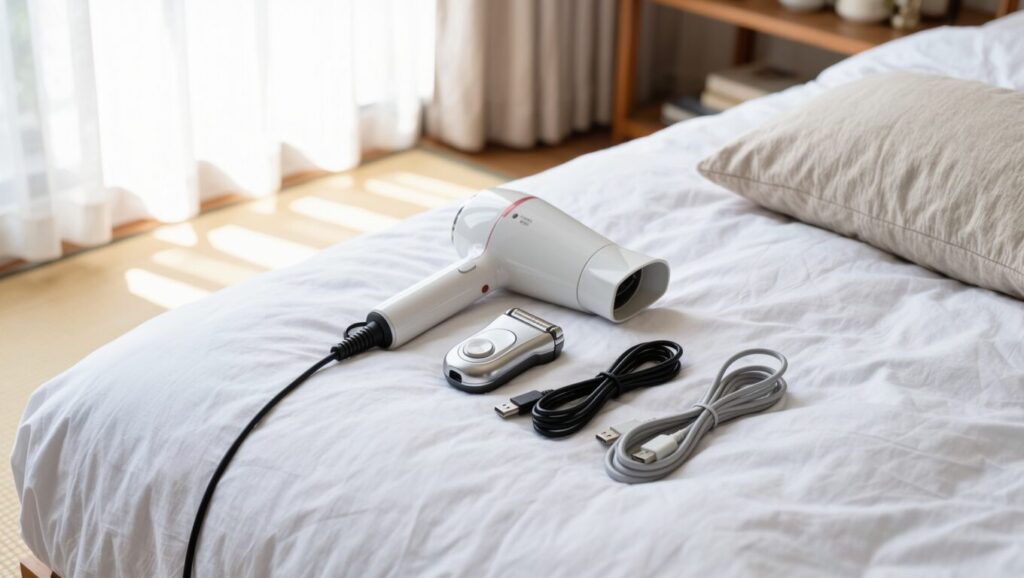
Chargers travel easily. Heat-producing devices are the ones to check the label on.
| Device | Usually dual voltage? | What to do |
|---|---|---|
| Phone, tablet, earbuds charger | Yes (100–240V) | Plug adapter only |
| Laptop power brick | Yes, check the brick | Plug adapter only |
| Camera battery charger | Usually yes | Plug adapter only |
| Electric shaver | Often yes, or battery-powered | Check for "100–240V" |
| Hairdryer (UK/EU/AU) | Check the label | If it doesn't cover 100V, leave it; use the hotel's |
| Straightener, curling iron | Sometimes | Check the barrel or cord |
| Electric toothbrush base | Usually yes | Plug adapter only |
Shavers are the one where it pays to look. Panasonic says its range splits into domestic-only and dual-use models, with most current models dual-use at "AC100~240V automatic voltage switching" — and that domestic AC100V-only shavers cannot be used abroad, warning that even with a transformer the voltage may become unstable. The same logic runs in reverse for your shaver coming into Japan. The label decides.
Panasonic is equally blunt about hairdryers: a 100V-only dryer "cannot be used overseas", and a transformer is not a safe workaround.
One note for North Americans. Your hairdryer's plug fits, but Japan supplies 100V rather than the 120V you have at home, so check that the rating label covers 100V before you rely on it.
🌐 Does 50Hz versus 60Hz matter to you?
Almost certainly not, but the fact is genuinely odd and worth knowing.
JNTO notes the voltage is uniformly 100 volts nationwide, while eastern Japan runs at 50 hertz and western Japan — including Nagoya, Kyoto and Osaka — runs at 60 hertz. Sharp's support page puts the dividing line around the Fuji River in Shizuoka and Itoigawa in Niigata.
Your charger doesn't care, because it's rated for 50–60Hz anyway. Frequency only matters for things with motors, which Sharp warns can change speed on the wrong frequency. You are not bringing those on holiday.
Worth flagging one disagreement: the UK's Electrical Safety First lists Japan simply as "100V supply voltage and 50 Hz frequency". For a traveller the difference is irrelevant, but if you're reading a one-line summary somewhere, that's why it may not mention 60Hz.
🏨 Hotel sockets: good to know where they are
The adapter question is easy. Knowing where the sockets sit is the useful extra.
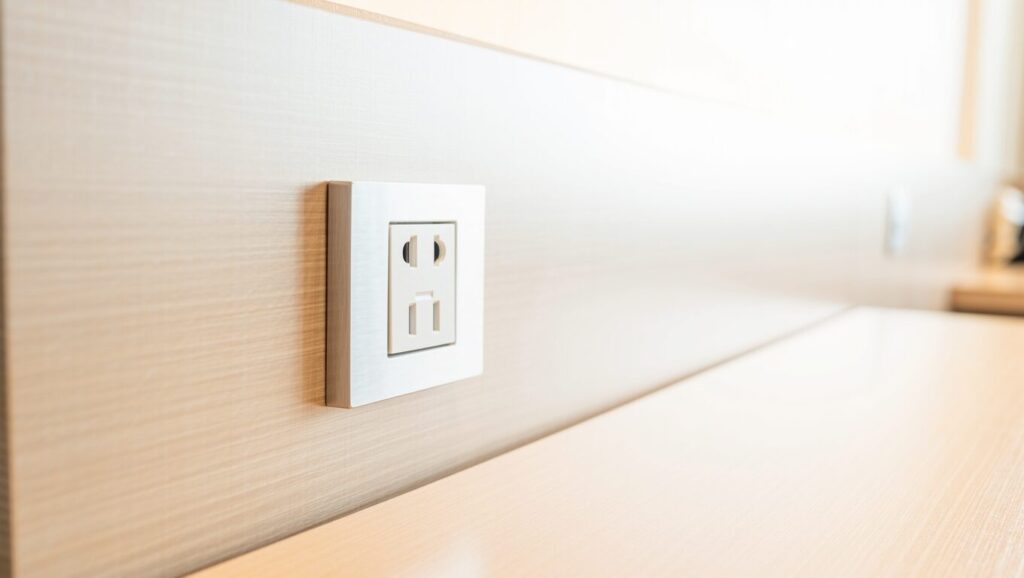
Japanese business hotel rooms are efficiently laid out, so sockets tend to cluster around the desk and the bathroom mirror. Newer builds add bedside power: Toyoko Inn's official rooms page describes a USB power supply installed next to the bed, and a hair dryer "installed on the wall near the desk area".
Which gets to the useful conclusion — at chains such as Toyoko Inn, a hairdryer is already in the room, so check your hotel's room amenities before you pack one. That covers the straightener question too, if you're happy using what's provided for a week.
Two things make a real difference to the evening:
Pack a small power strip or a multi-port USB charger. One Japanese plug feeding four devices beats carrying four adapters and hunting for four sockets. This is the single best packing decision for a trip here.
Plan for the bedside socket being in use. Lamps and clocks often take it. A short extension cable costs very little and buys you a phone charging within arm's reach.
If you forget an adapter entirely, Japan is a forgiving place to forget it in. JNTO points travellers to electronics districts like Akihabara in Tokyo and big retailers including Yodobashi Camera and Bic Camera for conversion plugs and transformers. Kashimura, a Japanese maker, sells a multi adapter that accepts twelve foreign plug shapes and outputs Type A — the exact thing a visitor wants, rated 15A/125V, with its own page stating clearly that it cannot change voltage.
❓ FAQ
Do I need a voltage converter for Japan?
Only if you're bringing a device labelled 220–240V that you absolutely must use. Nearly every charger is 100–240V and needs no converter.
Will my UK or European hairdryer work in Japan?
Only if its label covers 100V. Otherwise, use the hotel's dryer, or buy a dual-voltage travel model before you fly.
My US hairdryer has the right plug. Is it fine?
The plug fits, but Japan supplies 100V rather than 120V. Check that the rating label covers 100V; if it doesn't, use the hotel's dryer.
Is Japan Type A or Type B?
Type A — two flat pins, no earth — is what you'll meet in hotel rooms. Earthed three-pin sockets exist, but don't count on one.
Can I buy an adapter after I land?
Yes. Electronics chains and airport shops stock them, and Akihabara-style districts have walls of them.
The short version
- Japan is 100V, two flat pins, 50Hz in the east and 60Hz in the west
- US, Canadian and Mexican two-pin plugs fit as they are; UK, EU, Australian and NZ plugs need one cheap adapter
- Look for "100–240V" on your charger — if it's there, an adapter is all you need
- Hairdryers, straighteners and older shavers are the items to check the label on; chains such as Toyoko Inn supply a dryer in the room, so check your hotel's amenities
- A power strip or multi-port charger is the handiest thing to pack, since bedside sockets are often already in use
Next action: go and read the small print on your phone charger and laptop brick tonight. If both say 100–240V, your entire electrical packing list is one plug adapter and one power strip.
Show sources
- Japan Electrical Outlet (Plug and Electricity) — Japan National Tourism Organization (JNTO) (accessed 2026-10-06)
- About Apple USB power adapters — Apple (accessed 2026-10-06)
- 海外で使えるシェーバーは (Which shavers can be used overseas) — Panasonic (accessed 2026-10-06)
- 海外で使えるヘアドライヤー・くるくるドライヤーは (Which hair dryers can be used overseas) — Panasonic (accessed 2026-10-06)
- 【コンセント】100Vコンセントの差込口は、長さが違うのは何故か (Why are the slots of a 100V outlet different lengths) — Panasonic (accessed 2026-10-06)
- 電源周波数地域(50Hz地域/60Hz地域)について (Power frequency regions) — Sharp (accessed 2026-10-06)
- Travel Adaptor for Japan / Japan Plug Type — Electrical Safety First (UK) (accessed 2026-10-06)
- 国内用マルチ変換プラグ12種類対応→A WH (WP-79J multi plug adapter to Type A) — Kashimura (accessed 2026-10-06)
- 海外国内用大型変圧器 100V/110-130V/1000VA (WT-4UJ transformer) — Kashimura (accessed 2026-10-06)
- Recharge Your Mind & Body — Rooms & Services — Toyoko Inn (accessed 2026-10-06)

Keep reading
Vegetarian, Vegan or Allergic in Japan: Eat Without Stress
Dashi hides in dishes that look like vegetables, and restaurants don't have to list allergens. How to read a Japanese food label,…
No Bins in Japan? Where to Throw Rubbish and How to Sort It
Why Japan has so few public bins, where to put your rubbish (konbini, vending machines, your hotel), and a sorting table with…
What to Pack for Japan in Summer: Humidity, Heat and Cooling Gear
Japan's summer is about humidity more than heat. What to wear, how many shirts, rainy-season dates by region, and the cooling gear…